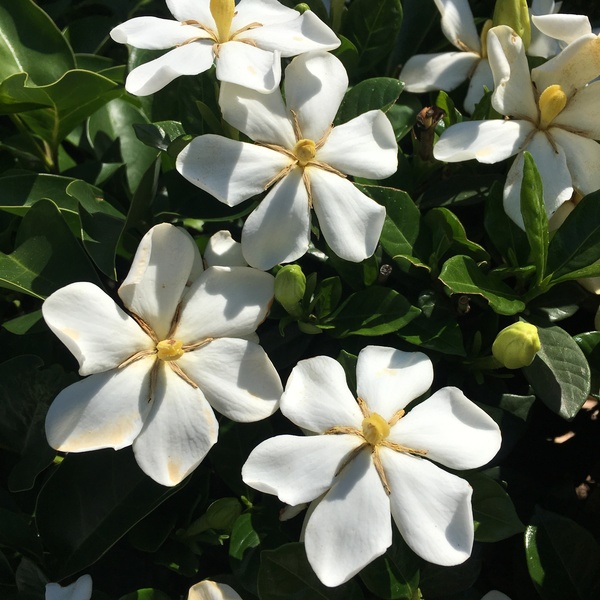
Gardenia jasminoides var. jasminoides(common gardenia, "Kuchinashi")
Japanese name: クチナシ(梔子) Scientific name:Gardenia jasminoides var. jasminoides
[Overview]
An evergreen shrub 1–2 m tall, found in evergreen broad-leaved forests and at forest edges on somewhat dry hills.
It branches freely.
The leaves are opposite, oblong, 5–12 cm long and 2–5 cm wide, with entire margins and a glossy surface.
There are 5–8 pairs of lateral veins.
The flowers are borne singly at the branch tips; they are 5–6 cm across and white, and the corolla is usually 6-lobed, opening flat, with a strong fragrance.
The fruit is obovate to elliptic, 2–3 cm long and about 2 cm wide, with 6 ridges, and the calyx lobes remain long at the tip.
The fruit ripens to orange-yellow.
[Uses]
Besides being used as a garden tree, the flowers are used to scent perfume and tea.
The fruit is also used as a yellow dye for cloth and to color foods such as takuan (pickled radish) and kurikinton (sweet chestnut paste).
The fruit is also used in Chinese herbal medicine.
[Cultivation]
Propagate by cuttings.
It prefers fertile, moderately moist places in partial shade.
It must be protected from cold winter winds and frost.
It suffers feeding damage from Osukashiba larvae.
[Notes]
One theory holds that the Japanese name comes from "kuchinashi" ("no mouth"), because the fruit does not open.