
Plant Encyclopedia

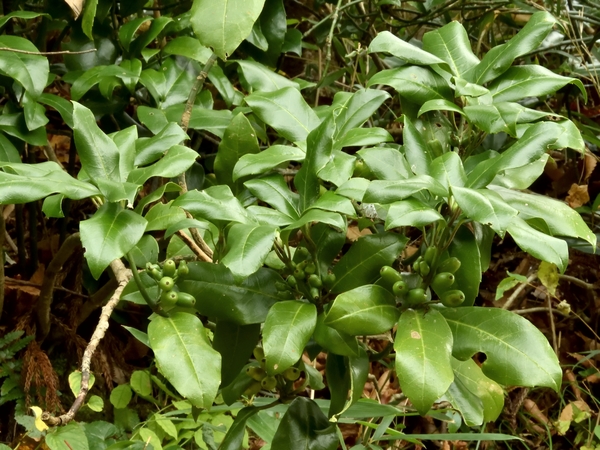
Aucuba japonica var. borealis ("Himeaoki")
Japanese name: ヒメアオキ (姫青木)
Scientific name: Aucuba japonica var. borealis
[Overview]
An evergreen shrub found in forests and at forest edges in heavy-snow regions.
It is smaller overall than Aoki, and young buds and inflorescences are covered with many appressed hairs.
The branches are dark green, and the trunk branches well from the base and, instead of standing upright, creeps sideways close to the ground.
Leaves are simple and opposite, broadly elliptic-ovate to broadly lanceolate, thick, with a glossy upper surface.
The leaf margins have coarse serrations.
The leaves turn black when dried.
It has leaf stalks.
It is dioecious.
Panicles are produced at the branch tips.
The flowers are small, 4-petaled, and purplish brown.
Male flowers have 4 stamens and a disc, and female flowers have a horn-shaped ovary.
Female plants bear fruit; the fruit is an elliptic drupe that ripens red.
[Uses]
The leaves are used as a folk remedy.
[Cultivation]
Propagate from seed, cuttings, or layering.
For seed, collect fully ripe fruit, wash off the pulp thoroughly with water, and sow immediately.
Cultivation is easy.
It grows from sun to shade, but strong direct sunlight in summer can scorch the leaves.
It prefers slightly moist, fertile soil, and poor drainage can cause root rot.
For potted plants, water thoroughly when the soil surface dries.
In spring, apply slow-release fertilizer at the base of the plant.
It dislikes pruning, but if pruning is done, cut above a node.
Pests and diseases include brown spot, anthracnose, scale insects, tea red spider mite (Chano-hokoridani), and the Aoki gall midge (Aoki-mitamabae).
Details
Translated from our Japanese encyclopedia. If anything differs, the Japanese page is correct.