
Plant Encyclopedia

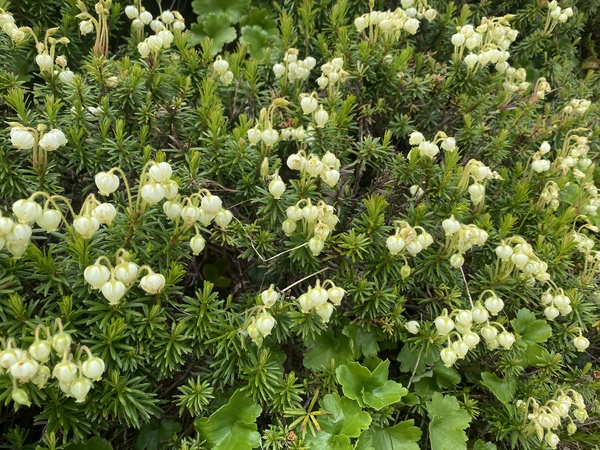
Phyllodoce aleutica ("Aonotsugazakura")
Japanese name: アオノツガザクラ (青栂桜)
Scientific name: Phyllodoce aleutica
[Overview]
An evergreen dwarf shrub 10–30 cm tall, found in moist grassland and on rocky ground in alpine areas, such as around snow patches.
The stems creep along the ground, with the upper part rising upright.
Leaves are alternate and dense, linear, 0.8–1.5 cm long, with very fine serrations on the margin.
Umbels at the branch tips bear 4–10 yellow-green flowers hanging downward.
The corolla is urn-shaped, about 0.6 cm long, with a shallowly 5-lobed tip.
There are 10 stamens, with hairless filaments and yellow anthers.
The calyx is green and 5-lobed, with broad lanceolate lobes about half as long as the corolla, and the outer base is densely covered with glandular hairs.
The flower stalk is slender, 1.5–2 cm long, with fine hairs and glandular hairs.
The fruit is an elliptical capsule.
[Cultivation]
Propagate from seed, by division, or by cuttings.
It prefers well-drained soil.
It is good to use potting soil for alpine and wild plants, a mixture of pumice and kanuma soil, or mountain sand mixed with a little sphagnum moss.
From autumn to spring keep it in a sunny place; in summer move it to an airy place in partial shade so that it stays cool.
Avoid the afternoon sun, direct sunlight in summer, and dry cold winds in winter.
In regions with snow cover it can overwinter buried under the snow, but in regions with little snow it is good to provide protection from frost and wind.
It should not be kept too wet but dislikes dryness, so take care that it does not dry out too much; water in the morning from autumn to spring, and in summer after the temperature drops in the evening.
Fertilize sparingly: apply base fertilizer, and as needed apply liquid fertilizer once every 2 weeks to 1 month in spring or autumn, making sure no fertilizer remains in midsummer.
Aphids can occur.
Details
Translated from our Japanese encyclopedia. If anything differs, the Japanese page is correct.