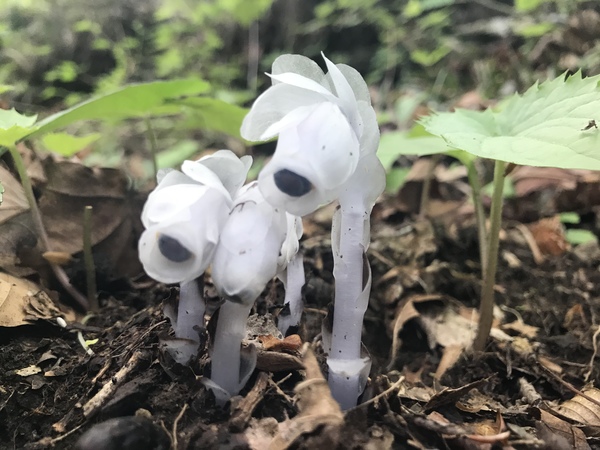
Japanese name: ギンリョウソウ(銀竜草) Scientific name:Monotropastrum humile
[Overview]
A mycoheterotrophic plant 8–20 cm tall, found in moist, humus-rich shaded ground on the floor of mountain forests.
It is a perennial.
It has no chlorophyll, and the whole plant is translucent white.
Underground there is a spherical tuber-like mass formed of a thick, short rhizome and densely tangled roots.
One to several thick aerial stems rise upright from the mass.
The stem is unbranched and bears alternate scale leaves.
The scale leaves are long ovate, entire and translucent, and those at the base of the stem are smaller.
A single flower is borne at the stem tip, facing downward, tubular and about 1.5 cm long.
The flower is also white, though sometimes slightly tinged with red.
The sepals resemble the scale leaves, being oblong and entire.
The petals are slightly longer than the sepals and rounded at the tip.
The pistil is a short cylinder shaped like a flask, and the margin of the stigma is blue.
The fruit is a spherical berry.