
Plant Encyclopedia

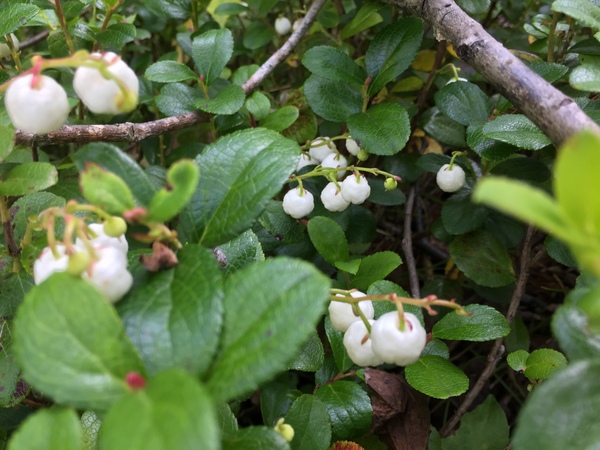
Gaultheria pyroloides ("Shiratamanoki")
Japanese name: シラタマノキ (白玉木)
Scientific name: Gaultheria pyroloides
[Overview]
An evergreen dwarf shrub often found on sunny, dry rocky ground in the subalpine to alpine zones.
It forms colonies with Akamono, Iso-tsutsuji and others.
The whole plant has a distinctive smell like methyl salicylate, which is used in poultices and similar products, and the smell is especially strong in the fruit.
The stems creep along the ground, and the upper parts rise to a height of 10–20 cm.
Leaves are simple and alternate, elliptic and about 2 cm long, thick, with the upper surface sunken along the veins and the underside tinged with white.
The leaf margins have small blunt serrations.
Racemes 2–6 cm long arise from upper leaf axils or branch tips and bear 2–6 flowers.
The flowers face downward, are urn-shaped and white.
The tip of each anther has 4 spiny projections.
Each flower has 1 scale-like bract and 2 small bracts.
The fruit is a capsule, but the calyx swells and encloses the fruit, forming a spherical berry-like structure 1 cm in diameter.
The fruit is white, sometimes tinged with pink.
[Cultivation]
Propagate from seed or by cuttings.
It prefers a sunny, well-drained, well-ventilated place, but in warm regions it is best kept cool in partial shade in summer.
Also protect it from dry cold winds in winter.
Water when the soil surface dries, taking care to avoid heat and humidity; in summer, water in the evening or later, once the temperature has dropped.
Do not let it become extremely dry in winter either.
Fertilize sparingly: either place slow-release fertilizer or organic fertilizer on the soil in spring, or give diluted liquid fertilizer once every 2 weeks in spring and autumn, making sure no fertilizer remains in midsummer.
There are no particular pests or diseases.
Details
Translated from our Japanese encyclopedia. If anything differs, the Japanese page is correct.