
Plant Encyclopedia

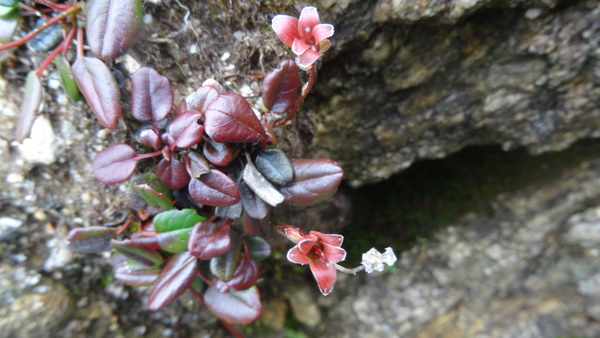
Epigaea asiatica ("Iwanashi")
Japanese name: イワナシ (岩梨)
Scientific name: Epigaea asiatica
[Overview]
An evergreen subshrub found on slopes at forest edges in the mountains.
The stems creep along the ground and spread, reaching 10–25 cm long, with coarse reddish-brown long hairs.
The leaves are simple and alternate, ovate, 4–10 cm long and 2–4 cm wide, with a pointed tip.
The leaf texture is somewhat leathery.
The leaf margin has coarse hairs.
A raceme at the branch tip bears 3–8 flowers.
The flowers are pale pink, and the corolla is tubular, 1 cm long, with a 5-lobed tip.
There are 10 stamens; a long vertical pore opens at the tip of each anther and releases the pollen.
The ovary is spherical and covered with glandular hairs.
At the base of each flower there is 1 bract and 2 bractlets.
The fruit is an oblate capsule about 1 cm across, enclosed in a thin pericarp tinged green to reddish brown, and the placenta becomes fleshy.
Many blackish-brown seeds cover the surface of the placenta.
The fruit is sweet and tastes like a pear.
[Cultivation]
Propagate by division or shoot cuttings.
When repotting, do so without breaking up the root ball, so as not to damage the roots.
It prefers a well-ventilated place with well-drained soil.
In cold regions it can be kept in the sun all year, but in warm regions move it to a cool, partially shaded place in summer.
Also protect it from dry, cold winter winds.
Water thoroughly when the soil surface dries.
In spring and autumn, apply slow-release fertilizer placed on the soil, or give diluted liquid fertilizer about once every 2 weeks.
There are no particular pests or diseases.
Details
Translated from our Japanese encyclopedia. If anything differs, the Japanese page is correct.