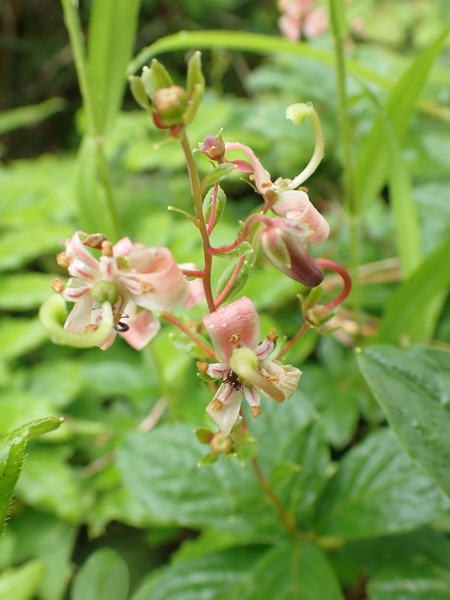
Japanese name: ミヤマホツツジ(深山穂躑躅) Scientific name:Elliottia bracteata
[Overview]
A deciduous shrub 0.3–0.5 m tall, found at forest edges and in shrub woodland from the subalpine to the alpine zone.
It branches freely from the base.
Young branches are hairless and almost without ridges.
Leaves are simple and alternate, obovate, 1–5 cm long and 0.7–2 cm wide; the leaf tip is rounded or slightly notched, and the base gradually narrows into the petiole.
The leaf margin is entire.
A raceme at the branch tip bears 3–20 flowers sparsely.
There are bracts at the base of the inflorescence.
The flowers are greenish white tinged with pale pink; the corolla is deeply 3-lobed, and the tips of the lobes curve back.
The pistil projects far out of the flower and curves upward.
The calyx is 5-lobed to the base.
The fruit is a flattened globose capsule without a stalk.
[Cultivation]
Propagate from seed or by cuttings.
It prefers sun to partial shade, good ventilation, and well-drained acidic soil.
Take care that it does not dry out in summer; for potted plants, water thoroughly when the soil surface dries, and for plants in the ground, rainfall is sufficient unless sunny weather continues and the soil becomes dry.
Apply organic fertilizer in winter.
There are no particular pests or diseases.