
Plant Encyclopedia

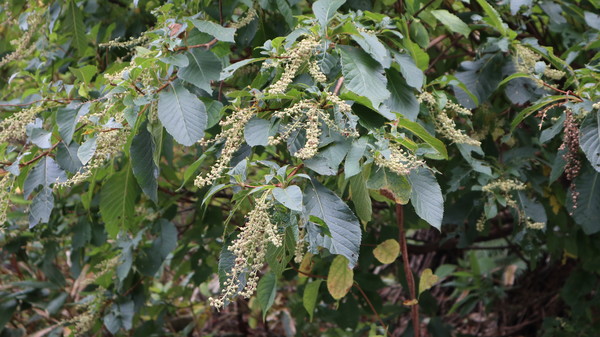
Clethra barbinervis (Japanese clethra, "Ryobu")
Japanese name: リョウブ (令法)
Scientific name: Clethra barbinervis
[Overview]
A deciduous small tree 3–6 m tall, growing on sunny mountain slopes, ridges and in dry woods.
The crown is umbrella-shaped.
The bark is reddish brown and peels off in thin pieces, giving the trunk a mottled appearance.
Leaves are simple and alternate, tending to cluster at the branch tips, where they appear almost whorled.
The leaves are obovate, 6–15 cm long and 2–7 cm wide, with sharp serrations.
Several racemes 10–20 cm long emerge at the branch tips, densely bearing white 5-petaled flowers.
The petals are 6–7 mm long, and the stamens are longer than the petals.
The fruit is a globose capsule 3–4 mm across, densely covered with hairs.
The seeds are flat and elliptic, 1 mm long.
[Uses]
The new shoots are boiled to remove bitterness and cooked with rice to make "ryobu-meshi."
It is said that in the past the young leaves were dried and stored as famine relief food.
The wood is used for tokobashira (alcove posts).
It is also a nectar source plant.
[Cultivation]
Propagate from seed or by cuttings.
It prefers sun and humus-rich soil that is well drained and retains moisture well.
It tolerates shade, but flowering is poor if sunlight is insufficient.
It dislikes strong afternoon sun.
Cultivation is easy.
For potted plants, water thoroughly when the soil surface dries.
For plants in the ground, rainfall is sufficient unless sunny weather continues for a very long time.
In winter, apply a small amount of organic fertilizer.
Powdery mildew can occur.
[Notes]
There is a theory that the Japanese name derives from the fact that, as a famine relief plant, it was required by law to be stored in preparation for famines.
Details
Japanese: リョウブ(令法)、ミヤマリョウブ(深山令法)、チャボリョウブ(矮鶏令法)、ハタツモリ(畑守)、サルスベリ(猿滑)
Translated from our Japanese encyclopedia. If anything differs, the Japanese page is correct.