
Plant Encyclopedia

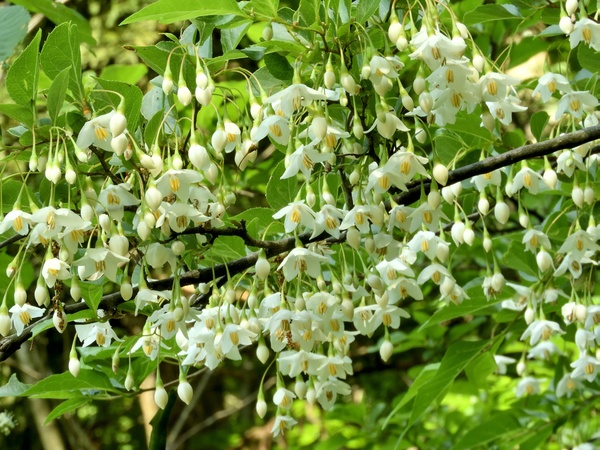
Styrax japonica var. japonica ("Egonoki")
Japanese name: エゴノキ
Scientific name: Styrax japonica var. japonica
[Overview]
A deciduous small tree 7–8 m tall, found in mountain valleys and mixed woodlands.
The bark splits finely lengthwise.
Leaves are simple and alternate, elliptic, 2–14 cm long and 1–7 cm wide, whitish beneath, with tufts of hair in the vein axils.
The leaf margin is almost entire or has low teeth.
The petiole is 0.3–1 cm.
Racemes at the tips of side branches hang white flowers in groups of 1–4, so that many flowers appear lined up in a procession along the underside of the branch.
The corolla is deeply 5-lobed, with 10 stamens attached at the base.
When the flowers fall, the corolla drops off whole, and when it lands on water it floats with the stamens standing upright in its center.
The flower stalk is slender, 2–3 cm long, and hairless or with stellate hairs.
The fruit is ovoid, 1 cm long, densely covered with stellate hairs and grayish white.
When ripe, the fruit splits lengthwise and releases one large brown seed.
[Uses]
The fruit skin and seeds contain a toxic component called egosaponin, and were once used for washing clothes and as a fish poison.
The seeds were also used as the filling of otedama (Japanese juggling bean bags).
The wood is white and is used for lathe work and similar crafts.
[Cultivation]
Propagate from seed, by grafting, or by layering.
A fertile or sandy soil that is sunny, well drained, well aerated and moderately moist is suitable.
Avoid dry places and places exposed to strong afternoon sun.
It is somewhat sensitive to dryness and sea wind.
It can be transplanted up to a trunk circumference of about 30 cm.
Take care that it does not dry out; for potted plants, water thoroughly when the soil surface dries.
Apply organic fertilizer around the plant as fertilizer in winter, and after flowering give a small amount of slow-release chemical fertilizer or oil cake as thanks fertilizer.
Do not prune hard; only thin out branches and maintain the natural form.
Pests and diseases include teppo-mushi (longhorn beetle larvae), Egonoki aphids and bark beetles.
[Notes]
The Japanese name is said to derive from the acrid taste of the fruit.
Various galls form on the leaves, buds and other parts, caused by gall midges, a kind of psyllid, or a kind of aphid.
The Flora Japonica describes the gall formed on the winter buds, called Egono-nekoashi-fushi, which was likened to a "cat's foot."
The bird yamagara likes the seeds of the fruit and deftly eats them by holding them between its feet.
Details
Translated from our Japanese encyclopedia. If anything differs, the Japanese page is correct.