Japanese name: ヒコサンヒメシャラ(英彦山姫沙羅) Scientific name:Stewartia serrata
[Overview]
A deciduous tree up to 15 m tall, found in deciduous forests in the mountains.
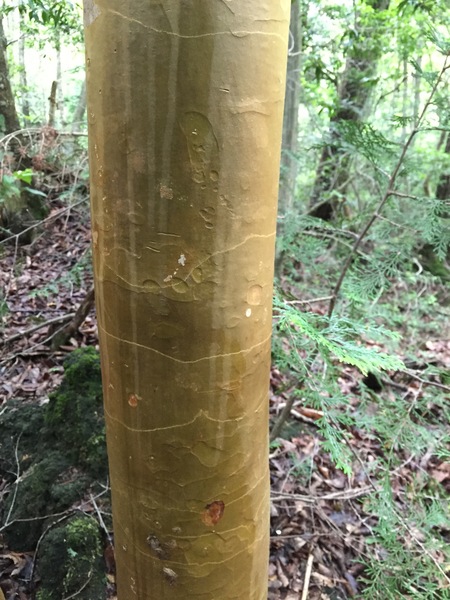
The bark peels off in fine, thin flakes.
Young branches are at first covered with white hairs.
Leaves are simple and alternate, elliptic to ovate-elliptic, 3–8 cm long and 1.5–3 cm wide, with shallow serrations on the margin.
The underside of the leaf has hairs along the veins or is almost hairless.
Flowers are borne singly in the leaf axils and face upward.
The flowers are white with 5 petals, 3.5–4.5 cm across, and are shaped like those of the Tsubaki.
The petals are serrated on the margin and densely covered with silky hairs on the outside.
The fruit is an elliptic capsule with 5 ridges.
The seeds are surrounded by broad wings.
It resembles Hime-shara, but can be distinguished by its larger flowers and seeds and by the bracts and sepals being almost the same length.
[Cultivation]
Propagate from seed or by cuttings.
It prefers a sunny, fertile site.
It is easy to grow, but care is needed against the tea tussock moth (Chado-kuga).
[Notes]
The Japanese name derives from the fact that it was discovered on Hikosan in Kyushu.