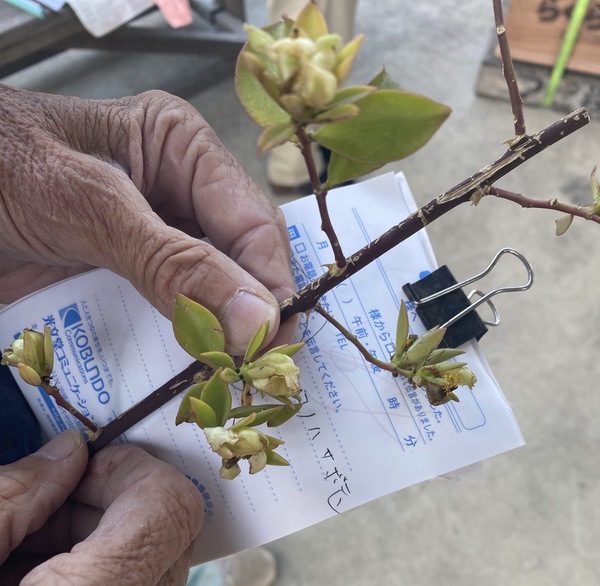
Japanese name: モクキリン(杢キリン、杢麒麟) Scientific name:Pereskia aculeata
[Overview]
A member of the cactus family, a climbing woody plant.
It is usually evergreen, but in its native habitat it loses its leaves in the dry season.
The stems are 2–3 cm in diameter and branch; they first stand upright, then use their spines to climb trees and other plants up to 10 m high.
The stems bear woody, straight spines in clusters, which become more numerous and longer as the stem ages.
The leaves are simple and alternate, lanceolate to oblong, 4–11 cm long and 1.5–4 cm wide, somewhat fleshy, with pointed tips and entire margins.
The new shoots and undersides of the leaves are often tinged with red.
Cymes or panicles bear many fragrant white to pale yellow flowers 2.5–5 cm across.
There are many yellowish-white to orange stamens.
The fruit is spherical, about 2 cm in diameter, and ripens from white to pink, yellow, orange, or red, bearing small spines and leaf-like structures.
[Uses]
In its native habitat, the leaves and fruit are eaten.