
Plant Encyclopedia

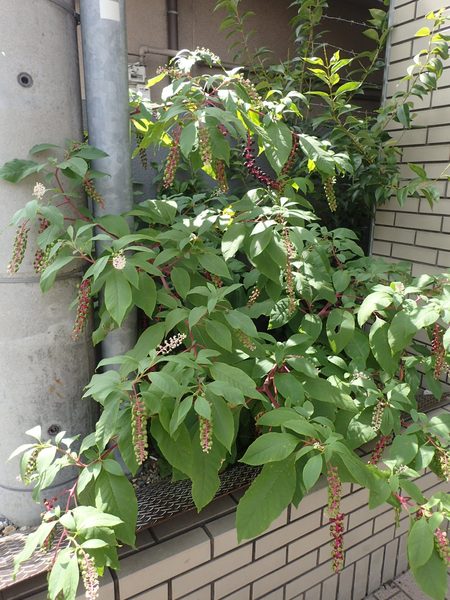
Phytolacca americana (American pokeweed, "Yoshuyamagobo")
Japanese name: ヨウシュヤマゴボウ (洋種山牛蒡)
Scientific name: Phytolacca americana
[Overview]
A perennial 0.7–2.5 m tall, found along roadsides and on vacant lots.
It has burdock-like roots underground.
The stem branches well in the upper part, is hollow, and is often tinged with reddish purple.
Leaves are simple and alternate, elliptic, 5–30 cm long and 2.5–13 cm wide.
The leaves are hairless, entire, and slightly succulent.
The petiole is 2–6 cm long and often tinged with reddish purple.
A raceme 6–21 cm long is produced opposite a leaf.
The inflorescence has a stalk 3.5–11 cm long.
The inflorescence is erect at flowering and hangs down at the fruiting stage.
The flowers are 4–6 mm across, white, sometimes tinged with crimson, with 5 petal-like parts.
There are no petals, and the petal-like calyx is conspicuous.
The fruit is a glossy, oblate berry about 8 mm across, ripening black.
[History]
It arrived in the Meiji period and has become naturalized throughout Japan.
[Uses]
The whole plant is poisonous, but the root is used medicinally.
It is also used as a material for dye and ink.
In addition, in the traditional cuisine of its native region the leaves and stems are used, and it was once also used to color wine.
Details
Japanese: ヨウシュヤマゴボウ(洋種山牛蒡)、アメリカヤマゴボウ
Translated from our Japanese encyclopedia. If anything differs, the Japanese page is correct.