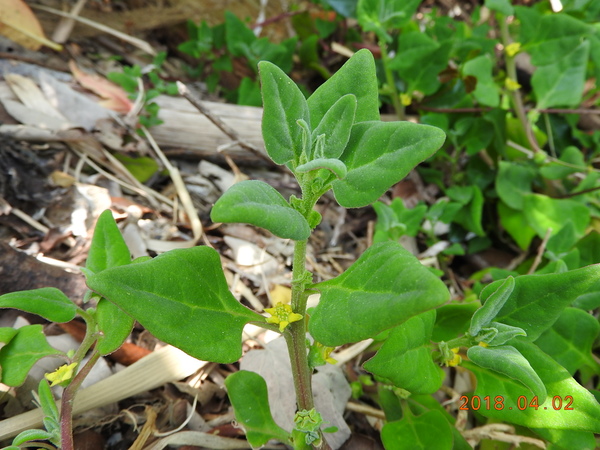
Japanese name: ツルナ(蔓菜) Scientific name:Tetragonia tetragonoides
[Overview]
A perennial 40–60 cm tall, found on sandy seashores.
The whole plant is somewhat succulent and slightly rough because of fine granular projections.
The stems branch well, and the lower parts creep along the ground.
Leaves are simple and alternate, rhombic to hastate, 4–6 cm long and 3–5 cm wide.
They have petioles 1–2 cm long.
One or two flowers are borne in each leaf axil; there are no petals, but there is a yellow calyx with 4–5 lobes.
The fruit is woody and hard, drupe-like, about 1 cm across, with 4–5 spiny projections, and resembles the fruit of the water chestnut.
The fruits are dispersed by ocean currents.
[Uses]
The stems and leaves are eaten.
The whole plant is used as a folk remedy.