
Plant Encyclopedia

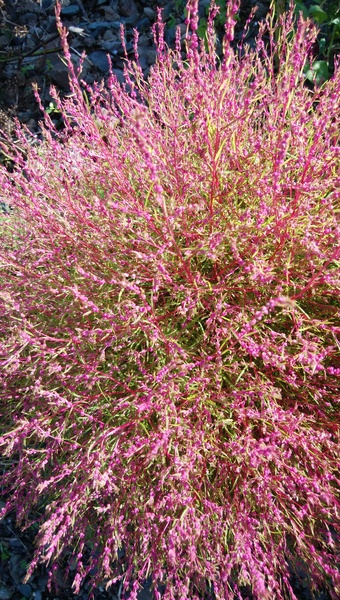
Bassia scoparia var. scoparia (burningbush, "Hokigi")
Japanese name: ホウキギ (箒木)
Scientific name: Bassia scoparia var. scoparia
[Overview]
An annual 50–100 cm tall.
The stems branch well and grow densely.
The leaves are simple and alternate, lanceolate, 2–5 cm long and 0.3–0.7 cm wide, with entire margins.
The leaves are somewhat thick, with three conspicuous veins, and usually have brown hairs on both surfaces.
Some strains turn a vivid red in autumn.
There are bisexual and female flowers, both borne 1–3 in the leaf axils, solitary or in spike-like inflorescences.
The flowers are small, 0.2–0.3 cm across, and yellowish green and inconspicuous.
The fruit is a utricle.
[Uses]
The fruit is used medicinally and is also eaten under the name "tonburi".
The young leaves can also be used as a vegetable.
Dried stems were bundled and used as brooms.
[Cultivation]
Propagate from seed.
It has a taproot and dislikes transplanting, so sow directly where it will grow, or sow in plastic pots and transplant carefully without breaking up the root ball.
It grows into a bulky plant, so leave 50 cm between plants.
It prefers sunny, well-drained, well-ventilated soil.
In poor light, growth suffers and the autumn color is poor.
Water thoroughly when the soil surface dries, but take care because it dislikes excess moisture.
If basal fertilizer is applied, no further fertilizer is particularly needed; if growth is poor, apply liquid fertilizer, but take care because fertilizer high in nitrogen disturbs the plant's shape.
In overly wet conditions, gray mold and powdery mildew may occur.
[Notes]
Some authorities treat Iso-hokigi, which grows on sandy and muddy ground by the sea, as a separate species.
Iso-hokigi is distributed in Japan (Kanto region to Kyushu), Korea and northeastern China.
Details
Japanese: ホウキギ(箒木)、ホウキグサ(箒草)、とんぶり、イソホウキギ(磯箒木)、イソボウキ(磯箒)、コキア
Translated from our Japanese encyclopedia. If anything differs, the Japanese page is correct.