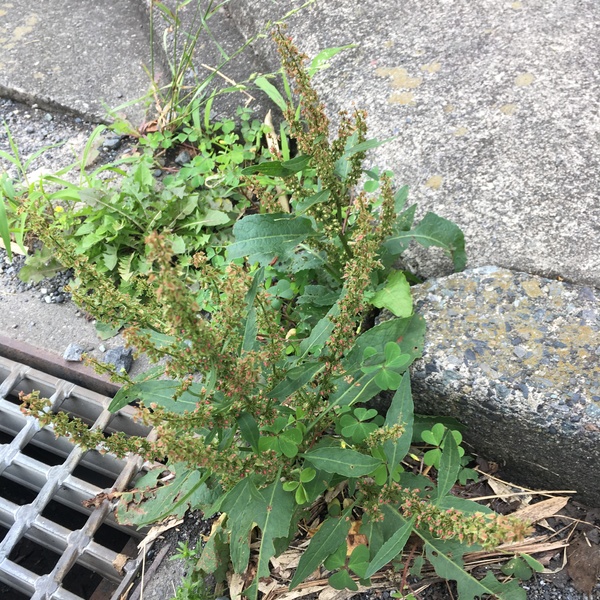
Japanese name: エゾノギシギシ Scientific name:Rumex obtusifolius
[Overview]
A perennial 50–130 cm tall, found along roadsides and in vacant lots.
The stem is erect and branches in the upper part.
There are basal leaves and leaves alternate on the stem; the basal leaves have usually withered by the flowering season.
The leaves on the lower part of the stem are 12–25 cm long and 5–12 cm wide, long ovate to oblong-ovate, with a cordate base; the midrib is often reddish, there are fine hairs (papillate projections) on the veins on the underside, and the margins are strongly wavy; they have petioles.
The flowers are densely borne in a panicle-like inflorescence, with small leaf-like bracts that are inconspicuous.
The flowers are small and have no petals.
The sepals are winged, triangular-ovate, with 2–4 pairs of spiny projections on the lower margin.
Only one of the three sepals has a reddish knob-like projection in the center.
The fruit is an achene.
[History]
It is thought to have arrived in the mid-Meiji period and has become naturalized in various places.