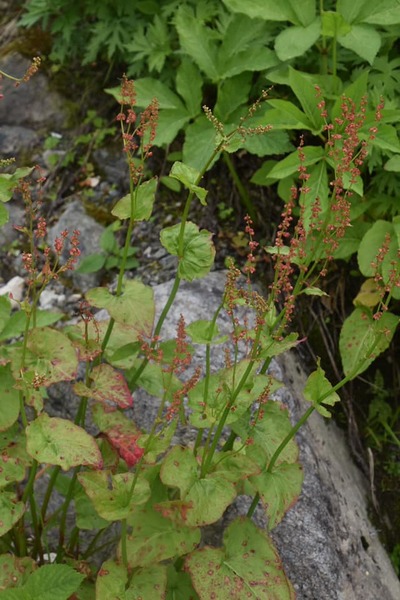
Japanese name: タカネスイバ(高嶺酸葉) Scientific name:Rumex alpestris subap. lapponicus
[Overview]
A perennial 30–100 cm tall, found in moist grasslands in the high mountains.
It has a thick, short underground stem.
The stem usually does not branch.
There are basal leaves and stem leaves, 3–10 cm long and 1–4 cm wide, ovate to triangular-ovate, with the base spreading slightly in an ear-like shape.
The basal leaves and the lower stem leaves have petioles, while the upper stem leaves are sessile.
The ocrea (sheath formed by the stipules) has an entire margin.
It is dioecious.
A panicle-like inflorescence at the stem tip bears small flowers densely.
The flowers have no corolla.
The fruit is an achene, enclosed by the calyx, which develops into wings.
[Notes]
Like Suiba, it contains oxalic acid and therefore has a sour taste.