
Plant Encyclopedia

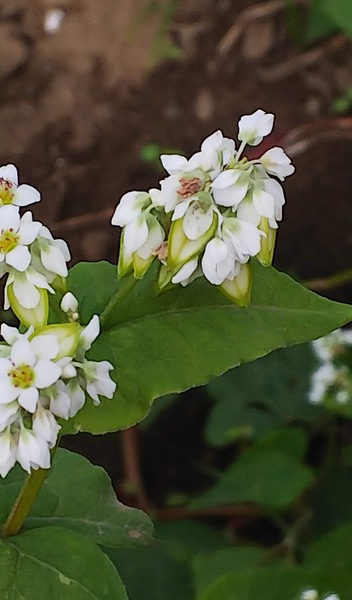
Fagopyrum esculentum (common buckwheat, "Soba")
Japanese name: ソバ (蕎麦)
Scientific name: Fagopyrum esculentum
[Overview]
An annual 0.7–1.3 m tall.
The stem is erect and much branched, and in some plants it is tinged with red.
Leaves are simple and alternate, triangular, 3–7 cm long, with entire margins.
Racemes arising at the stem tips and from the upper leaf axils bear flowers 5–6 mm across.
The flowers have no petals; the white to red calyx is conspicuous and looks like petals.
It is self-incompatible.
The flowers come in two types, long-styled (with a long pistil and short stamens) and short-styled (with a short pistil and long stamens), and they do not set fruit unless pollinated with each other's pollen.
The fruit is a triangular-pyramidal achene 6–8 mm long with 3 ridges.
[Uses]
The seeds are used for buckwheat flour, and are also used as a raw material for buckwheat tea and shochu.
The young leaves are eaten.
Buckwheat hulls are used as pillow filling and the like.
[Cultivation]
Propagate from seed.
It prefers a sunny, well-drained, well-ventilated place.
In fertile soil it lodges and sheds its seeds easily, so cultivation in poor soil is better.
It prefers slightly acidic soil, but grows without problems unless the site is very wet.
It is resistant to dryness; for potted plants, water thoroughly after the soil has dried, and for plants in the ground, rainfall is sufficient.
Fertilize sparingly; if a base fertilizer is applied, nothing more is particularly needed.
Cutworms can occur.
Details
Japanese: ソバ(蕎麦)
Translated from our Japanese encyclopedia. If anything differs, the Japanese page is correct.