
Plant Encyclopedia

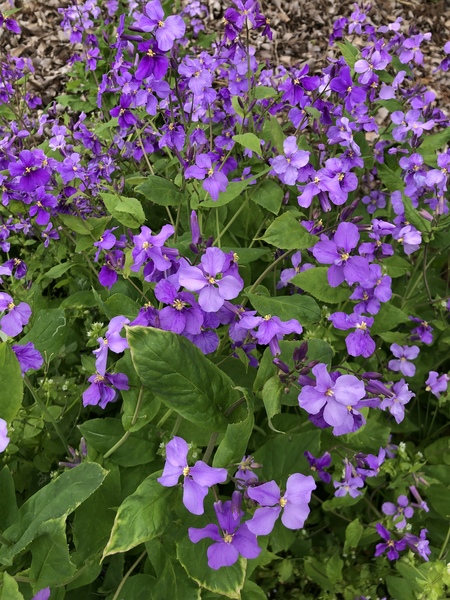
Orychophragmus violaceus var. violaceus (Chinese violet cress, "Shokatsusai")
Japanese name: ショカツサイ (諸葛菜)
Scientific name: Orychophragmus violaceus var. violaceus
[Overview]
A biennial 10–60 cm tall, seen near human habitation on roadsides, embankments and farmland, often growing in colonies.
It is almost hairless throughout.
The stem is erect and branches in the upper part.
There are both basal leaves and stem leaves.
The basal leaves and the leaves on the lower part of the stem are deeply pinnately lobed and have petioles.
The leaves on the upper part of the stem are alternate, with coarse teeth on the margins, and their bases clasp the stem.
The undersides of the leaves are slightly whitish.
Racemes at the stem tips bear large, pale purple four-petaled flowers 2–3 cm across.
The calyx is purple and tubular.
The fruit is a silique 7–10 cm long with 4 ridges.
[History]
It arrived in the Edo period and was cultivated for ornament and for oil, and many plants have become naturalized.
[Cultivation]
Propagate from seed.
It also spreads readily from self-sown seed.
In a sunny, well-drained place it is not particular about soil and grows well even in poor soil.
It tolerates partial shade, but then becomes leggy and flowers poorly.
Rainfall is sufficient for watering.
There are no particular pests or diseases, but if leaf miners (Hamoguri-bae, also called ekakimushi) attack, white lines appear on the leaves as if drawn.
Details
Japanese: ショカツサイ(諸葛菜)、ハナダイコン(花大根)、オオアラセイトウ、ヒロハハナダイコン(広葉花大根)、ムラサキハナナ(紫花菜)
Translated from our Japanese encyclopedia. If anything differs, the Japanese page is correct.