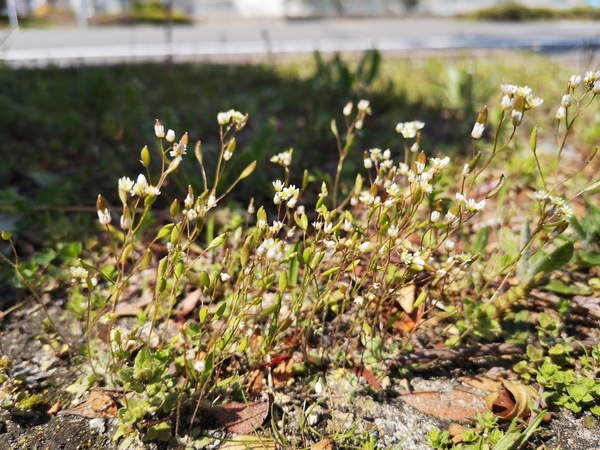
Japanese name: ヒメナズナ(姫薺) Scientific name:Draba verna
[Overview]
A biennial found along roadsides and similar places.
The plant usually produces only basal leaves forming a rosette; they are oblong to oblanceolate, 0.5–2.5 cm long, narrowing at the base into a leaf stalk, with entire margins or a few teeth.
Both surfaces of the leaves are densely covered with simple hairs and stellate hairs.
The flower stalk is erect and bears white four-petaled flowers, 0.3 cm across, in spikes.
The petals are ovate and deeply 2-lobed at the tip, so depending on the depth of the cut the flower may look eight-petaled.
The sepals are ovate.
The flower stalk and calyx are often tinged with reddish purple.
The flower stalk grows to about 20–30 cm tall at the fruiting stage.
The fruit is a flat, elliptic to oblong silicle 0.2–0.9 cm long, and is hairless.
The seeds are very small, elliptic, and yellowish brown.
[History]
It was first collected around 1900 in Ueno Park, Tokyo, and has become naturalized in Hokkaido and Honshu.