
Plant Encyclopedia

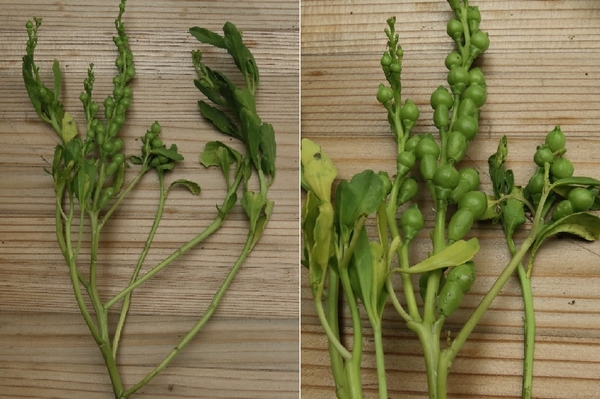
Cakile edentula (American searocket, "Onihamadaikon")
Japanese name: オニハマダイコン (鬼浜大根)
Scientific name: Cakile edentula
[Overview]
An annual or biennial 15–50 cm tall, found on coastal sandy ground and dunes.
The root is a cylindrical, rather thick taproot.
The whole plant is fleshy and hairless.
The stem branches freely at the base.
Leaves are alternate, oblong to obovate, and simple and undivided; they vary from entire or wavy-margined to shallowly pinnately lobed.
There is a short leaf stalk.
Racemes arise at the stem tips and from the leaf axils, bearing white to pale purple four-petaled flowers about 0.8 cm across.
In fruit, the axis of the inflorescence becomes zigzag.
The fruit consists of 2 segments: the upper is spherical to egg-shaped with a pointed tip, and the lower is cylindrical, a shape compared to a brush tip or a kokeshi (a Japanese wooden doll); it has a short stalk about 0.3 cm long.
When ripe, the fruit separates at the segments, and each segment contains one seed.
The fruits are dispersed by ocean currents.
[History]
It was discovered in 1982 on a coastal sandy area in Murakami, Niigata, and has since become naturalized on coasts from Hokkaido to Honshu (on the Pacific side north of the Kanto region, on the Sea of Japan side north of the Kinki region).
Details
Japanese: オニハマダイコン(鬼浜大根)
Translated from our Japanese encyclopedia. If anything differs, the Japanese page is correct.