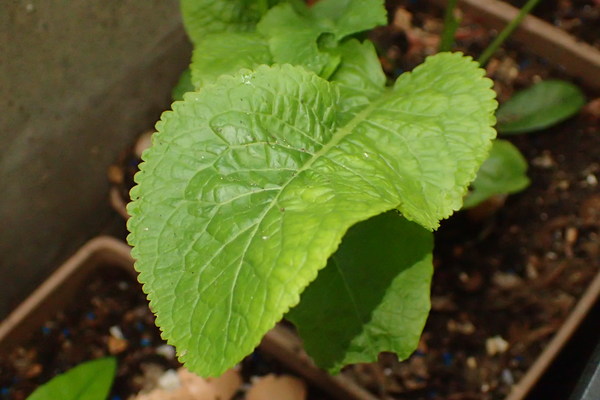
Japanese name: セイヨウワサビ(西洋山葵) Scientific name:Armoracia rusticana
[Overview]
A cold-hardy perennial.
The leaves grow from the base and have long leaf stalks; they are large and spatulate, with scalloped, slightly wavy margins.
At temperatures of 28°C or higher the leaves are round, and at 16°C or lower they produce fern-like divided leaves.
A flower stalk 50–80 cm long bears white four-petaled flowers in a raceme.
Seed is hardly ever set.
[History]
At the end of the 16th century it was used as a medicinal plant in England and in cooking in Germany.
It was introduced to Japan from America in the first years of the Meiji era (1873).
[Uses]
The enlarged root is strongly pungent and is used as a spice.
In commercial powdered wasabi and similar products, this plant is used in place of real wasabi.
[Cultivation]
It prefers well-drained, sunny, neutral to alkaline soil with a deep layer of cultivated earth.
Cool regions are suitable.
Harvest from November onward, once the above-ground parts begin to die back.
Propagate by root cuttings.