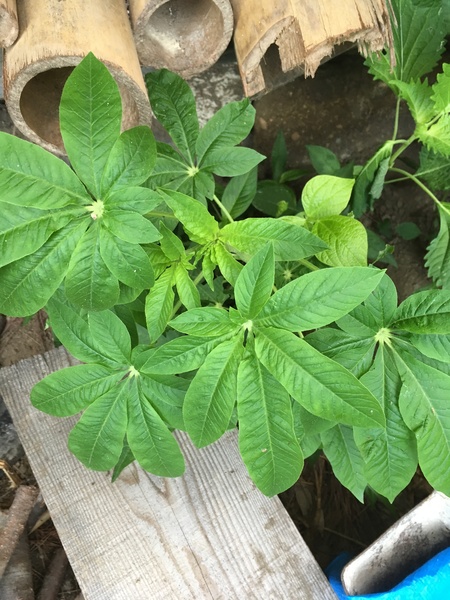
Japanese name: フウチョウソウ(風蝶草) Scientific name:Gynandropsis gynandra
[Overview]
An annual 30–90 cm tall.
The whole plant is covered with sticky hairs.
The stem is erect.
The leaves are alternate and palmately compound, consisting of 3–5 leaflets.
The leaflets are obovate, with finely toothed or entire margins.
They have long petioles.
Racemes at the stem tips bear white flowers with 4 petals.
The flower color may take on a pale pink tinge as the flowers age.
A stalk about 1.5 cm long extends from the center of the flower, and 6 stamens and 1 pistil protrude from its tip.
The fruit is a slender capsule about 10 cm long.
[Uses]
The leaves and flowers are eaten.
[Cultivation]
Propagate from seed.
It also spreads readily from self-sown seed.
It dislikes transplanting, so sow directly with about 30 cm between plants and thin out, or sow in plastic pots and transplant.
It prefers a sunny, well-drained location.
Cultivation is easy.
For potted plants, water thoroughly when the soil surface dries; for plants in the ground, rainfall is sufficient.
Apply basal fertilizer, and also place slow-release fertilizer on the soil once a month.
When the plant grows tall, set up stakes.
There are no particular pests or diseases.