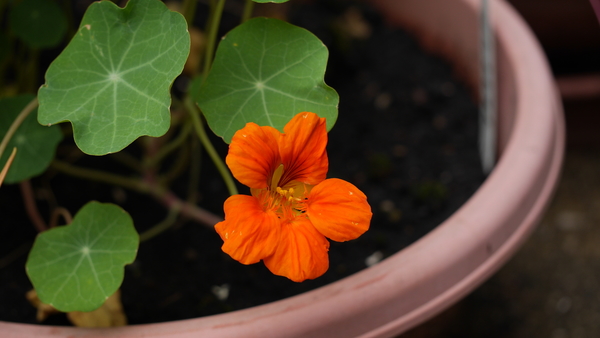
Japanese name: ノウゼンハレン(凌霄葉蓮) Scientific name:Tropaeolum majus
[Overview]
A climbing annual.
Long-growing plants can reach 3 m.
The stems and leaves are fleshy and succulent, and the whole plant is hairless.
It has long petioles, with which it twines around anything it touches and climbs.
The leaves are simple and alternate, round, peltate, with entire margins.
The flowers are borne singly in the leaf axils on long flower stalks.
The flowers are 5-petaled, 5–6 cm across, and yellow to orange.
The petals are rounded, and the upper 2 petals are somewhat smaller.
The base of the petals is claw-like.
There are 8 stamens.
The fruit is hard, and its skin is corky and wrinkled.
[Uses]
The leaves have a distinctive pungency and aroma and are used in salads.
The young green buds are sometimes used as a substitute for capers.
The flowers are also used in salads and other dishes.
[Cultivation]
Propagate from seed.
It prefers a sunny, somewhat dry place.
It is easy to grow, but when sown in autumn, care is needed against winter frost and cold wind.
[Notes]
Because the leaf shape resembles a knight's shield, it is regarded as a flower of victory in battle.