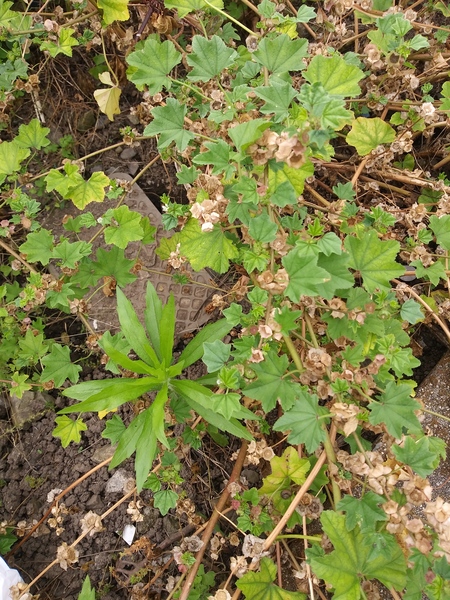
Japanese name: ウサギアオイ(兎葵) Scientific name:Malva parviflora
[Overview]
An annual or perennial 20–50 cm tall, found along roadsides and on vacant land.
The leaves are alternate, reniform-round, and shallowly 5–7-lobed.
The lobe tips are triangular and pointed, the margins have blunt teeth, and the upper surface is sparsely hairy.
The leaves have long stalks, which are sparsely hairy.
Several flowers are borne in bundles in the leaf axils, on short flower stalks.
The flowers are pale pink with 5 petals, 6–8 mm across.
The fruit is flat, 6–8 mm across, and divides into 10 mericarps; when ripe, the surface becomes depressed in a net-like pattern.
The edges of the mericarps are jagged, so that adjacent ones interlock.
[History]
It was first reported in Oiso, Kanagawa in 1948, and has since naturalized in various regions.
[Notes]
The Japanese name was coined by Tomitaro Makino from Toki (兎葵), the name given to the Chinese plant.