Japanese name: タイワンツナソ(台湾綱麻) Scientific name:Corchorus olitorius
[Overview]
A subshrub 1–2 m tall that is grown as an annual in cold regions.
In the tropics, some plants reportedly reach 4 m in height.
The stem branches freely.
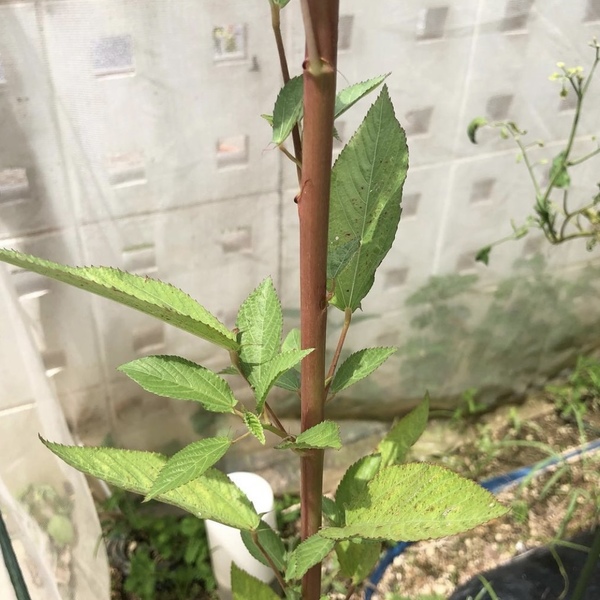
The leaves are simple and alternate, 2–10 cm long and 1–5 cm wide, ovate to oblong-ovate, with a pointed tip and a long whisker-like tail-like projection at the base.
The leaf margin is serrate.
The stipules are needle-shaped, up to 0.5–1 cm long.
The flowers are yellow with 5 petals, borne singly or in pairs opposite the leaves.
The fruit is a cylindrical capsule 2.5–7 cm long and about 0.5 cm in diameter, with 10 ridges and a narrowed tip bearing 5 small projections.
The seeds are poisonous.
[History]
It is cultivated as a vegetable and has become naturalized in warm regions and elsewhere.
[Uses]
It is used as a vegetable under the name moroheiya.
The fiber is of poor quality, but it is used as jute.
[Cultivation]
Propagate from seed.
It prefers a sunny, well-drained, well-ventilated, fertile soil rich in humus.
It is tolerant of heat and dryness and is easy to grow.
Pests and diseases include spider mites, scarab beetles and powdery mildew.