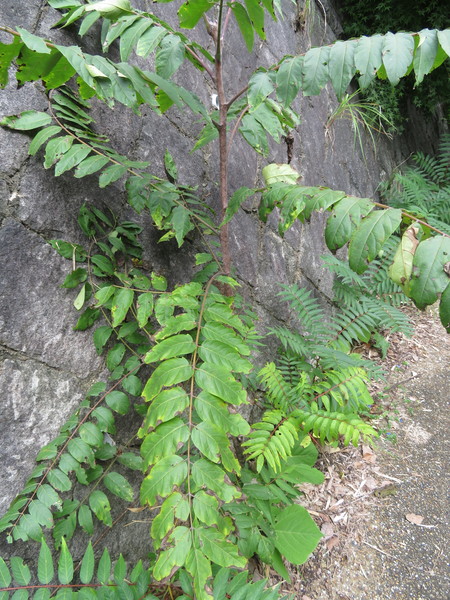
Japanese name: ニワウルシ(庭漆) Scientific name:Ailanthus altissima
[Overview]
A deciduous tree that can exceed 25 m in height in large specimens.
The leaves are alternate, odd-pinnately compound, 40–100 cm long, and consist of 13–25 leaflets.
The leaflets are long-ovate, 7–12 cm long and 2.5–5 cm wide, with pointed tips.
The lower part of the leaf margin has 1–2 pairs of blunt teeth.
It is dioecious.
Dense panicles at the branch tips bear many small greenish-white flowers with 5–6 petals.
The fruit is a flat, wing-like segment 4–4.5 cm long, with a small seed about 5 mm across in the center.
[History]
It arrived in Japan in the early Meiji era.
[Uses]
The bark is used medicinally.
[Cultivation]
Propagate from seed.
It is easy to grow in any soil as long as the site is sunny and well drained.
For potted plants, water thoroughly when the soil surface dries; for plants in the ground, rainfall is sufficient.
Fertilizer is not particularly necessary.
There are no particular pests or diseases.