
Plant Encyclopedia

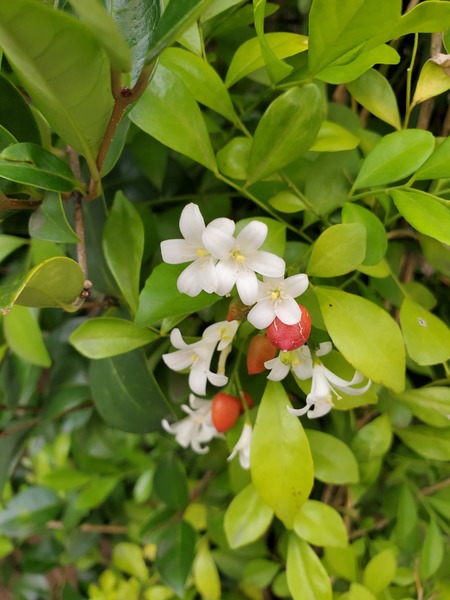
Murraya paniculata var. exotica (orange jasmine, "Gekkitsu")
Japanese name: ゲッキツ (月橘)
Scientific name: Murraya paniculata var. exotica
[Overview]
A shrub or small evergreen tree 3–8 m tall.
The bark is grayish white to pale brown.
Young branches are green and hairless, turning grayish white in the second year.
The leaves are alternate and odd-pinnately compound, about 4–10 cm long, consisting of 3–9 leaflets.
The leaflets are obovate-elliptic to obovate, 1.5–5 cm long and 1–3 cm wide, with entire margins, slightly notched tips, and bases that narrow and run into the leaflet stalk.
The leaves are somewhat thick and hairless on both sides; the upper surface is dark green and glossy, and the underside has sparse oil dots.
The leaflet stalks and leaf stalks have sparse short hairs.
It flowers all year round if the temperature is sufficient.
Corymbs arising at the branch tips or from the leaf axils bear several white 5-petaled flowers.
The flowers have a fragrance similar to citrus flowers, especially noticeable at night.
The fruit is an ovoid-globose to globose berry, 1–1.2 cm long, ripening red.
Flowers and fruit can sometimes be seen at the same time.
[Uses]
The flowers and ripe fruit are edible.
The leaves are used medicinally.
An essential oil can also be obtained.
The wood is hard and is used for walking sticks, handles of farm tools and knives, carvings, seals, combs and the like.
[Cultivation]
Propagate from seed or by cuttings.
It prefers sunny, well-drained soil.
It is safest to keep it at 5°C or above over winter, so move it to a sunny spot indoors in winter.
It drops its leaves if allowed to dry out, so take care not to let it run short of water; from spring to autumn, water thoroughly when the soil surface begins to dry, and in winter keep it on the dry side but do not let it dry out completely.
In spring to autumn, apply slow-release fertilizer placed on the soil.
Pests and diseases include scale insects and spider mites.
Details
Japanese: ゲッキツ(月橘)、オレンジジャスミン、シルクジャスミン
Translated from our Japanese encyclopedia. If anything differs, the Japanese page is correct.