
Plant Encyclopedia

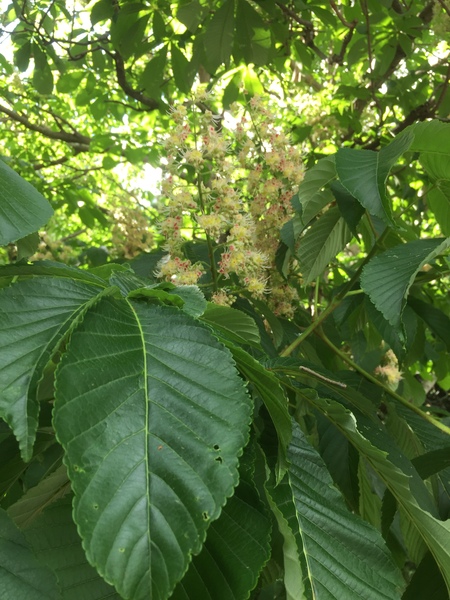
Aesculus turbinata (Japanese horse-chestnut, "Tochinoki")
Japanese name: トチノキ (栃、橡、栃の木)
Scientific name: Aesculus turbinata
[Overview]
A deciduous tree 20–30 m tall and up to 1 m in diameter, found in fertile places along streams and valleys in the mountains.
The bark splits into large pieces and falls off.
Ring-shaped bud scale scars and obovate leaf scars are conspicuous on the branches.
The leaves tend to cluster at the branch tips and are opposite and palmately compound.
There are 5–9 leaflets; the central leaflet is the largest, up to 30 cm long and 12 cm wide.
The leaf margin has fine serrations, and 20–30 pairs of lateral veins run almost parallel.
The petiole is 5–25 cm long.
The winter buds are large and sticky.
An upright, conical compound raceme 15–25 cm long and 5–10 cm across bears many flowers.
The flowers open sideways and are about 1.5 cm across, with 4 petals that are white with a pale pink pattern at the base.
There are 7 stamens, 1.5–2 cm long, longer than the petals and curving upward.
The fruit is a spherical capsule 3–5 cm across, with wart-like projections on the surface.
There are 1–2 seeds, which look like chestnuts.
[History]
Seeds have also been excavated from Jomon period sites, so its history as a food is long.
Because it was valued as a famine relief crop, some regions forbade felling the trees or letting them die.
[Uses]
The seeds, after the astringency is removed, are called "tochi-no-mi" and processed into tochi-mochi (rice cakes) and other foods.
The wood has a beautiful grain and is used as construction material and decorative material.
The bark is used for making tanned leather and as medicine.
It is also important as a nectar source plant.
[Cultivation]
Propagate from seed or by grafting.
Germination rate drops when seeds dry out, so sow them immediately after collecting.
A seedling takes 30 years to become a mature tree.
It grows large and takes up space, so a wide area is needed.
It prefers cool, moderately moist land, and sunny, moist, fertile soil.
It dislikes dryness and strong summer afternoon sun.
Water enough to prevent the soil from drying out.
For fertilizer, apply compost around the base in winter and when the fruit begins to set.
In warm regions and cities where the soil and air are dry, the leaf tips are damaged, so care is needed.
Also, because the leaves are large and thin, they are easily damaged by sea wind and strong wind.
Avoid transplanting mature trees.
Pruning is not particularly necessary, but if it bothers you, just thin out obstructing branches.
There are no particular pests or diseases.
Details
Japanese: トチノキ(栃、橡、栃の木)
Translated from our Japanese encyclopedia. If anything differs, the Japanese page is correct.