
Plant Encyclopedia

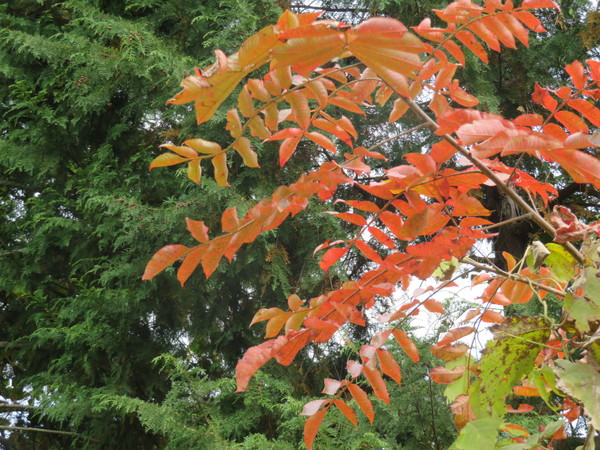
Rhus javanica (Chinese sumac, "Nurude")
Japanese name: ヌルデ (白膠木)
Scientific name: Rhus javanica
[Overview]
A deciduous small tree 4–7 m tall, found in secondary forests on flatland.
White latex comes out when the trunk is wounded.
Young branches are densely hairy.
Leaves are alternate, odd-pinnately compound, 20–40 cm long, and consist of 9–13 leaflets.
The leaflets are elliptic, 5–12 cm long and 2–8 cm wide, with slightly pointed serrations on the margins.
On the upper surface of the leaf, the midrib is hairy.
The undersides of the leaves are densely covered with soft hairs and appear yellowish brown.
The leaf rachis is winged.
The petiole is densely covered with soft hairs.
The leaves turn red in autumn.
Dioecious; both male and female flowers are borne in large numbers on panicles 20–30 cm long at the branch tips, and are small, yellowish white and 5-petaled.
The fruit is oblate, 3 mm across, ripens to yellowish red, and is densely covered with soft hairs.
White crystals (calcium malate) are secreted on the surface of the fruit.
[Uses]
The insect galls (gobaishi) that form on the leaves are used as a raw material for tannin and as medicine.
[Cultivation]
Propagate from seed.
It is easy to grow in any soil as long as the site is sunny and well drained.
Rainfall is sufficient for watering.
Fertilizer is not particularly necessary.
There are no particular pests or diseases.
[Notes]
Because the crystals on the surface of the fruit taste salty, it has the alternative name "Shionomi".
Details
Japanese: ヌルデ(白膠木)、フシノキ(五倍子木)、カチノキ(勝の木)、シオノミ(塩の実)
Translated from our Japanese encyclopedia. If anything differs, the Japanese page is correct.