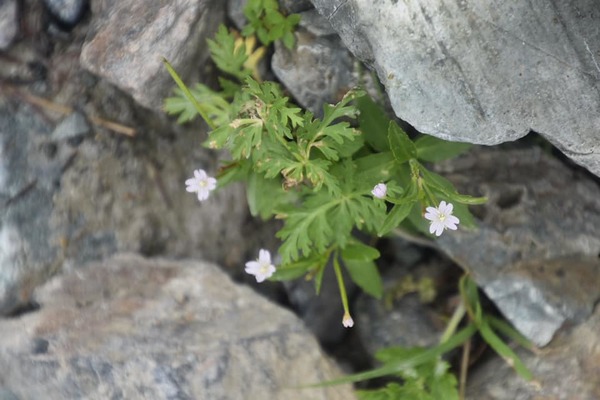
Japanese name: シロウマアカバナ(白馬赤花) Scientific name:Epilobium lactiflorum
[Overview]
A perennial 5–30 cm tall, found on moist rocky ground and gravelly areas such as alpine snowfields.
The stems often form clumps and have ridges bearing glandular hairs and white hairs.
Sometimes short stolons extend from the base of the stem and overwinter.
Leaves are simple and opposite, oblong to lanceolate, 2–5 cm long and 0.8–2.4 cm wide, and almost hairless.
The leaf margins have fine serrations.
The petioles are short.
Flowers are white, rarely pale pink, with 4 petals, and the tip of each petal is shallowly 2-lobed.
The outside of the calyx is densely covered with glandular hairs.
A slender ovary with glandular hairs lies below the flower.
The fruit is a slender club-shaped capsule 2–5 cm long and almost hairless.
The fruit stalk is 1.5–3 cm long.
When ripe, the fruit splits into 4 and releases seeds with a white pappus.
The seeds have no papillae and show a net-like pattern.