
Plant Encyclopedia

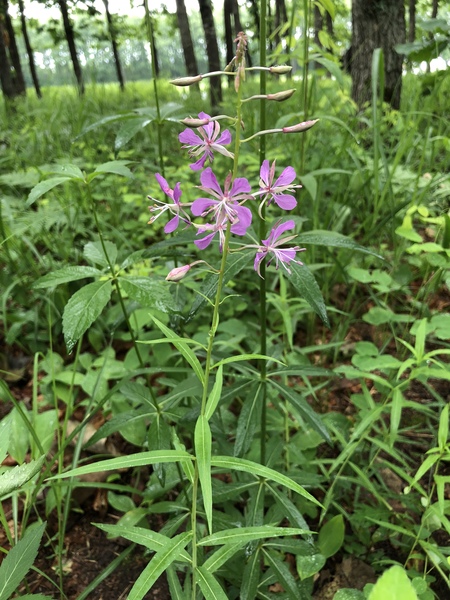
Chamerion angustifolium subsp. angustifolium (fireweed, "Yanagiran")
Japanese name: ヤナギラン (柳蘭)
Scientific name: Chamerion angustifolium subsp. angustifolium
[Overview]
A perennial 1–1.5 m tall, found in grasslands on highlands and often growing in colonies on logged land and sites of mountain fires.
The stem is erect, unbranched, and almost hairless.
Leaves are simple and alternate, lanceolate, 5–18 cm long and 0.5–2 cm wide, and whitish on the underside.
The leaf margins are almost entire.
The leaf stalk is very short or absent.
A raceme 10–45 cm long at the stem tip bears many reddish-purple 4-petaled flowers.
At the base of each flower stalk there is a slender, small bract.
The fruit is a slender capsule 5–8 cm long, which splits when ripe and releases seeds with white hairs.
[Uses]
The whole plant is used medicinally, and the young shoots are used as a wild vegetable or as a substitute for tea.
[Cultivation]
Propagate from seed, by division, or by shoot cuttings.
It prefers a cool climate.
It prefers sunny, well-drained soil and is somewhat sensitive to summer heat and humidity, which can cause leaf scorch, so in warm regions it is best placed in partial shade in midsummer.
Be careful not to let it dry out; water thoroughly when the soil surface dries.
In spring, apply slow-release fertilizer placed on the soil.
If you do not intend to collect seed, remove spent flowers frequently.
Pests and diseases include soft rot, powdery mildew, aphids, slugs and spider mites.
[Notes]
The Japanese name comes from the leaves resembling those of willow and the beauty of the flowers being compared to orchids.
Details
Japanese: ヤナギラン(柳蘭)
Translated from our Japanese encyclopedia. If anything differs, the Japanese page is correct.