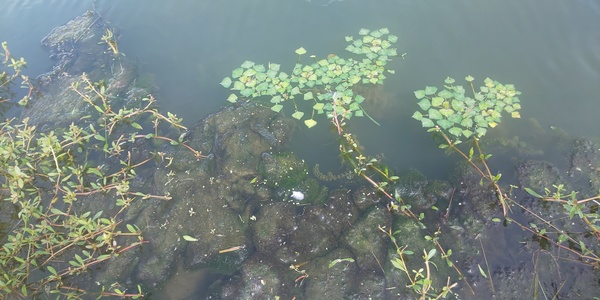
Japanese name: ヒシ(菱) Scientific name:Trapa japonica
[Overview]
An aquatic annual growing in ponds and marshes.
The stem is long and reaches the water surface; from the nodes it produces submerged leaves that are fully pinnately divided and look like roots.
The floating leaves are simple and alternate, clustered at the stem tip, spreading radially on the water surface, triangular-rhombic and about 5 cm wide, with triangular teeth on the upper margin.
The underside of the leaves is hairy.
The petiole is long and hairy, and swollen in the middle, where it serves as a float.
The flowers are solitary in the leaf axils, white with 4 petals, about 1 cm across.
The fruit is a slightly flattened, inverted-triangular nut with two sharp spines, one on each side.
The spines are two of the four sepals, developed.
[Uses]
The seeds are used as food and as a folk medicine.
[Notes]
Recent research has suggested that it may be a species derived from hybridization between Hime-bishi and Oni-bishi, or between their respective close relatives.