
Plant Encyclopedia

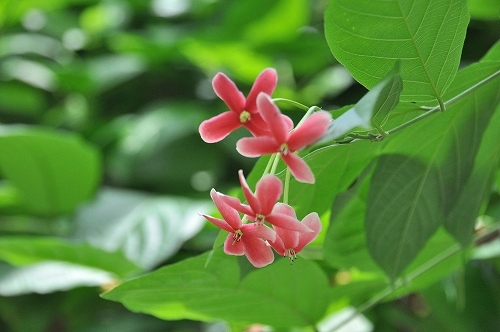
Quisqualis indica var. villosa (Rangoon creeper, "Shikunshi")
Japanese name: シクンシ (使君子)
Scientific name: Quisqualis indica var. villosa
[Overview]
An evergreen climbing shrub 2.5–8 m tall; it is shrub-like at first and later becomes a vine.
The leaves are simple and opposite, elliptic to oblong, 7–15 cm long, with pointed tips, short soft hairs on the underside, and entire margins.
There is a joint at the base of the leaf stalk, and when the leaf falls, the remaining part of the leaf stalk becomes spine-like.
Conical inflorescences emerge from the branch tips and leaf axils and bear many flowers.
The flowers have 5 petals and a sweet fragrance like that of peaches, and their color changes as they bloom.
They are white when they first open in the evening, pink on the second day, and red on the third day, so that a single plant looks as if it were flowering in different colors.
The color change is thought to be a strategy to increase pollinators such as hummingbird hawk-moths, bees and birds.
The orientation of the flowers also changes: they face sideways when they first open and later hang down.
The calyx tube is pale green and as much as 7–8 cm long, and is fused with the ovary; the petals alternate with the calyx lobes and are attached at the top of the calyx tube.
There are 10 stamens attached to the inner surface of the upper part of the calyx tube, and the style of the pistil emerges from partway down the inside of the calyx tube.
The fruit is a spindle-shaped dry fruit 3–3.5 cm long, with 5 distinct longitudinal ridges, and ripens to dark brown.
[History]
It has become naturalized on Ishigaki Island and Iriomote Island.
[Uses]
The fruit is called shikunshi (使君子) as a crude drug and is used as an anthelmintic against roundworms and the like, and to regulate the intestines.
The ripe seeds are sweet with an almond-like flavor and can be eaten after the seed coat and so on are removed, but it is said that there have been cases of people becoming ill after eating only 2–3.
[Cultivation]
Propagate by cuttings.
To overwinter it, bring it indoors to a sunny place in winter so that it can be kept at 13°C or higher.
It prefers sunny, well-drained soil.
For potted plants, water thoroughly from spring to autumn when the soil surface dries, and keep it on the dry side in winter; for plants in the ground, rainfall is sufficient.
In fertile soil fertilizer is not particularly necessary, but for potted plants, place slow-release fertilizer on the soil from spring to autumn.
There are no particular pests or diseases.
[Notes]
The Japanese name derives from the crude drug name and carries the meaning of a precious medicine bestowed by the emperor.
Details
Japanese: シクンシ(使君子)、インドシクンシ、ビロードシクンシ
Translated from our Japanese encyclopedia. If anything differs, the Japanese page is correct.