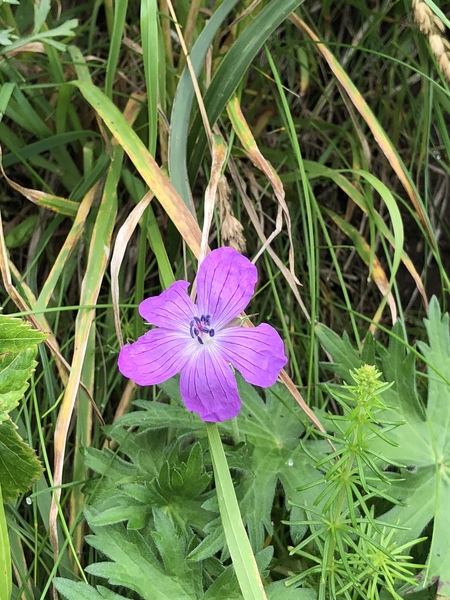
Japanese name: ハマフウロ(浜風露) Scientific name:Geranium yesoense var. pseudopalustre
[Overview]
A perennial 30–80 cm tall, found in grasslands along the coast.
The stems and leaf stalks have downward-pointing hairs.
There are basal leaves and stem leaves, and the basal leaves have long leaf stalks.
The leaves on the stem are usually opposite, pentagonal, 5–10 cm wide, and palmately divided into 5 lobes, with shallow incisions.
Two flowers are borne together at the stem tips and branch tips.
The flowers are 5-petaled, 2.5–3 cm across, and pale reddish purple.
The calyx has few hairs.
The fruit is a capsule.
[Cultivation]
Propagate from seed or by division.
It prefers a cool climate.
It prefers fertile soil that is well drained and retains moisture well.
In warm regions partial shade is better, and dry places, strong afternoon sun and winter north winds should be avoided.
When planting in the ground, it is good to plant it under deciduous trees.
Water thoroughly when the soil surface dries.
In spring and autumn, apply diluted liquid fertilizer; in midsummer it is better that no fertilizer remains.
Pests and diseases include aphids and spider mites.