
Plant Encyclopedia

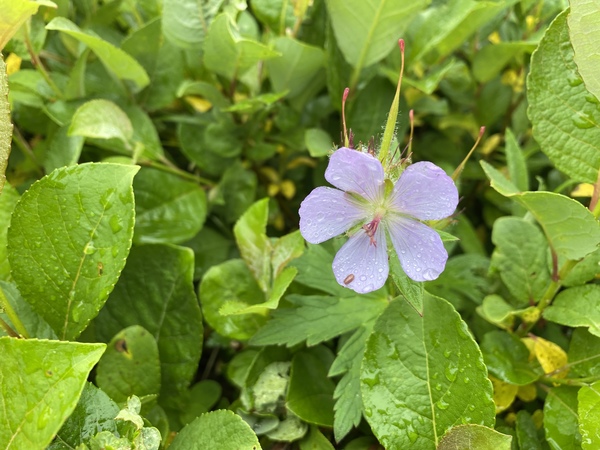
Geranium erianthum var. erianthum (woolly geranium, "Chishimafuro")
Japanese name: チシマフウロ (千島風露)
Scientific name: Geranium erianthum var. erianthum
[Overview]
A perennial 20–50 cm tall, found in alpine grasslands and, in Hokkaido, in grassy spots within woodland at low elevations.
It has a thick rhizome underground.
Sparse downward-pressed hairs grow on the stem and leaves, and spreading hairs grow densely on the inflorescence stalk, flower stalks and sepals.
The leaves are of two kinds, basal leaves and stem leaves; the basal leaves have long petioles and remain at flowering time.
The stem leaves are alternate in the lower part, while the uppermost pair is opposite; they are kidney-shaped, 5–12 cm wide, and deeply palmately divided into 5–7 lobes.
They have long petioles.
A cyme at the stem tip bears 3–12 flowers.
The flowers are 5-petaled, 2.5–3 cm across, and bluish purple to reddish purple.
The flower stalks are 0.5–1 cm long, extend sideways at flowering, and stand upright when in fruit.
The fruit is a capsule, which splits into 5 parts and bursts open when ripe.
[Cultivation]
Propagate from seed, by division, or by root cuttings.
It prefers well-drained soil in sun to partial shade.
It is hardy and very cold-tolerant.
It dislikes heat, humidity and direct summer sun, so move potted plants in summer to a cool, airy place in partial shade.
In the ground, it is best planted under deciduous trees or similar.
In warm regions, avoid places that get afternoon sun, especially the western sun in summer.
To prevent the soil temperature from rising, it may also be planted on a mound of soil about 20 cm high.
In cold regions, it grows well with little care if the environment suits it.
Protect it from cold winter winds.
For potted plants, water thoroughly in spring and autumn when the soil surface dries.
For plants in the ground, rainfall is sufficient.
Apply basal fertilizer, and also give liquid fertilizer in spring and autumn; it is better for no fertilizer to remain in midsummer.
Pests and diseases include soft rot, powdery mildew and spider mites.
Details
Japanese: チシマフウロ(千島風露)、エゾタチフウロ(蝦夷立風露)、オオフウロ(大風露)、レブンフウロ(礼文風露)
Translated from our Japanese encyclopedia. If anything differs, the Japanese page is correct.