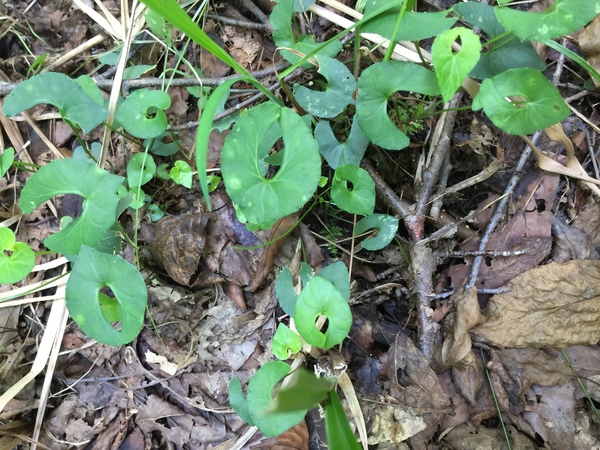
Japanese name: アギスミレ(顎菫) Scientific name:Viola verecunda var. semilunaris
[Overview]
A perennial found in wetlands and marshes from lowlands to mountains.
Many aerial stems arise from the base, growing erect or slanting upward, and reach about 10–20 cm tall.
The leaves after flowering are 2–5 cm wide and boomerang-shaped (crescent-shaped) with a deeply indented base, and the margins have low teeth.
Many of the leaves at flowering time are heart-shaped.
The stipules are lanceolate, with entire margins or a few teeth.
The flowers are borne at the tips of erect flower stalks arising from the leaf axils; they are about 1 cm across and white, with purple lines in the center of the lip petal.
The bases of the lateral petals are hairy, and a short spur of 2–3 mm extends behind the flower.
It does not usually produce aerial runners, and having basal leaves at flowering time is one of its characteristics.
The summer flowers are cleistogamous.
The fruit is a capsule that splits into 3 when ripe and scatters the seeds.