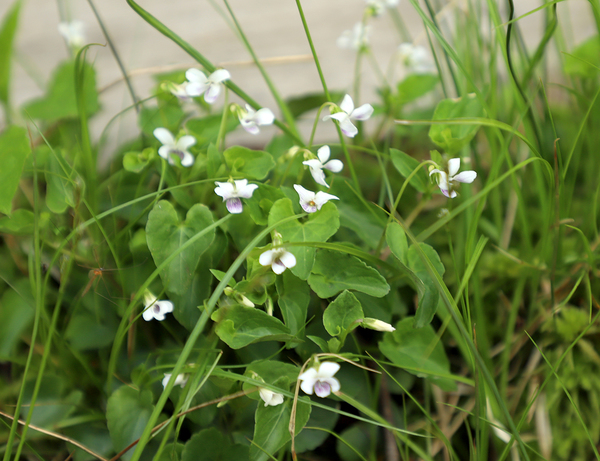
Viola verecunda var. fibrillosa("Miyamatsubosumire")
Japanese name: ミヤマツボスミレ(深山壷菫、深山坪菫) Scientific name:Viola verecunda var. fibrillosa
[Overview]
A perennial 5–25 cm tall, found in alpine wetlands and in grassland at forest edges.
The stems creep along the ground and send out roots from the nodes.
The leaves are round, 2–3.5 cm wide, with fine hairs on the surface.
The leaf margins have low serrations.
The stipules are lanceolate, with entire margins or a few serrations.
The flowers are borne at the tips of flower stalks that stand upright from the leaf axils, about 1 cm across, tinged with pale purple, with a purple stripe in the center of the lip petal.
Hairs grow at the base of the lateral petals, and there is a short spur behind the flower.
The flowers in summer are cleistogamous.
The fruit is a capsule that splits into 3 when ripe and scatters the seeds.