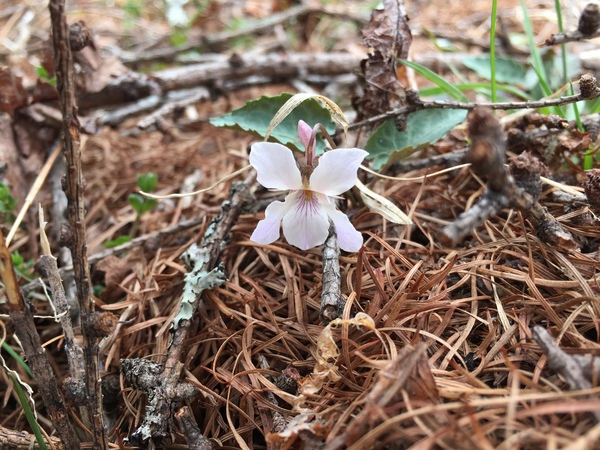
Japanese name: ヒナスミレ(雛菫) Scientific name:Viola tokubuchiana var. takedana
[Overview]
A perennial 5–8 cm tall, commonly seen in mountain forests, on slopes along streams and on slightly moist forest floors.
It has a short underground stem.
The leaves spread horizontally.
At flowering time the leaves are 2–5 cm long, long-ovate to lanceolate, with a heart-shaped base, and coarse hairs grow on both surfaces.
The undersides of the leaves are sometimes tinged with purple.
The leaf margins have low serrations.
The petiole is 3–10 cm.
The flowers are borne at the tips of flower stalks, 1.5–2 cm across, and pale reddish purple.
Sparse hairs grow at the base of the lateral petals.
A spur 6–7 mm long extends behind the flower.
The flower stalks do not elongate much, so the flowers appear to sit on top of the leaves.
The fruit is a capsule that splits into 3 when ripe and scatters the seeds.