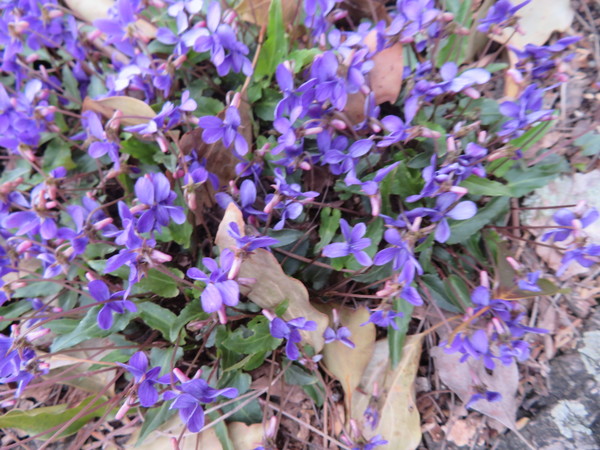
Japanese name: ヒメスミレ(姫菫) Scientific name:Viola inconspicua subsp. nagasakiensis
[Overview]
A violet seen by roadsides and similar places, a perennial 3–10 cm tall.
It has no aerial stem.
The leaves are basal with long petioles, triangular-lanceolate to spoon-shaped, 1.5–4 cm long.
The undersides of the leaves may be tinged with purple.
The leaf margins have low serrations.
At the fruiting stage the leaves reach 6 cm in length, and the base spreads out like an arrowhead.
The petioles have almost no wings.
The flowers are borne at the tips of upright flower stalks arising from the leaf axils; they are 1–1.5 cm across, deep purple to pale purple, and the center of the lip petal is white with purple lines.
The lateral petals have hairs at the base, and a slender spur extends behind the flower.
The summer flowers are cleistogamous.
The fruit is a capsule that splits into 3 when ripe and scatters the seeds.
[Cultivation]
Propagate from seed or by division.
It prefers sunny, well-drained soil rich in humus.
Water thoroughly when the soil surface dries.
In addition to basal fertilizer, apply diluted liquid fertilizer once every 2 weeks from spring to autumn.
It is easy to grow, but powdery mildew may appear.
Pests include aphids, spider mites, cutworms and Tsumaguro-hyomon.