EVERGREEN

Plant Encyclopedia

Euphyllophyta
Angiospermae
Malpighiales
Violaceae
Viola
Viola grypoceras var. grypoceras f. albiflora

Viola grypoceras var. grypoceras f. albiflora ("Shirobanatachitsubosumire")

Japanese name: シロバナタチツボスミレ (白花立壷菫)
Scientific name: Viola grypoceras var. grypoceras f. albiflora

Viola grypoceras var. grypoceras f. albiflora

[Overview]
A violet growing in woods and at woodland edges from lowlands to mountains, a perennial.
It has several aerial stems.
The leaves are basal with long petioles, heart-shaped, 1.5–2.5 cm long, with low serrations on the margin.
The stipules are deeply divided like the teeth of a comb.
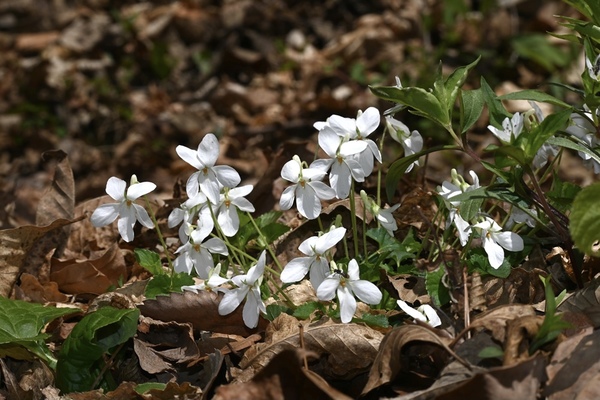
The flowers are borne at the tips of upright flower stalks 6–10 cm long arising from among the basal leaves or from the leaf axils; they are about 2.5–3 cm across, entirely white including the spur, and face sideways.
A spur extends behind the flower, and nectar collects in it.
The summer flowers are cleistogamous.
The fruit is a capsule that splits into 3 when ripe and scatters the seeds.

[Cultivation]
Propagate from seed, by cuttings, or by division.
It prefers partial shade and well-drained soil rich in humus.
It is easy to grow, but powdery mildew may appear.
Pests include aphids, spider mites, cutworms and Tsumaguro-hyomon.

Details

Names
Japanese: シロバナタチツボスミレ(白花立壷菫)
Life form
Perennial
Habit
Terrestrial
Planting (or sowing) season
February, March, September, October
Flowering season
March, April, May
Distribution or origin
Japan (Hokkaido to the Nansei Islands), Kuril Islands, southern Korea, China, Taiwan
Height
60–100 mm
Leaf shape
Simple leaf (unlobed)
Leaf arrangement
Alternate, Basal
Leaf margin
Serrate
Inflorescence
Solitary
Number of petals
5
Flower color
White
Flower diameter
25–30
Leaf color
Green
Availability of seeds and plants
Low
Form sold
Seeds, Seedlings
Propagation
Seed, Division, Bud cuttings
Sun exposure
Partial shade
Water needs
Moderate
Soil needs
Required
Suitable uses
Bonsai, Potted plant, Parks and gardens, Container
Diseases
Powdery mildew
Pests
Aphids, Spider mites, Armyworms, Indian fritillaries
Relationship with animals
Seeds have a white appendage (elaiosome) made of a substance ants like, and are dispersed by being carried by ants to their nests.
Japan Flower Trade Code
26821

Translated from our Japanese encyclopedia. If anything differs, the Japanese page is correct.

Sponsored