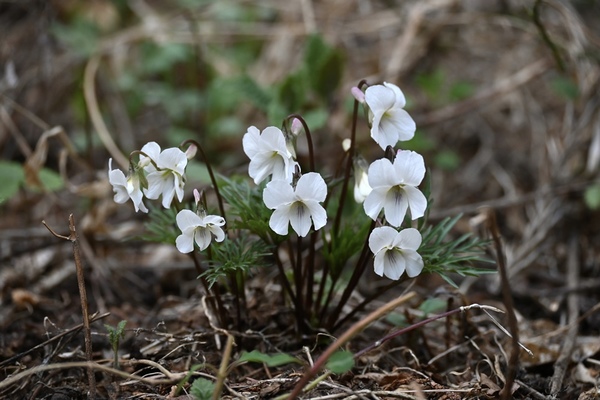
Viola chaerophylloides var. sieboldiana("Higosumire")
Japanese name: ヒゴスミレ(肥後菫) Scientific name:Viola chaerophylloides var. sieboldiana
[Overview]
A perennial 5–10 cm tall, found in sunny grasslands.
It has a short underground stem.
The leaves are basal, about 3–6 cm long, divided into 3 lobes down to the base, and the lobes are further deeply divided.
Leaves that appear at the fruiting stage reach as much as 10 cm in length.
The flowers are borne at the tips of erect flower stalks, about 1.5–2 cm across, and are white or have reddish-purple streaks on the back of the petals.
The flowers are fragrant.
A thick, short spur extends behind the flower.
The fruit is a capsule that splits into 3 when ripe and scatters the seeds.
[Cultivation]
Propagate from seed, by root cuttings, or by division.
It prefers sunny, well-drained soil rich in humus.
Water thoroughly when the soil surface dries.
In addition to base fertilizer, apply diluted liquid fertilizer once every 2 weeks from spring to autumn.
Pests and diseases include powdery mildew, aphids, spider mites, armyworms and the Indian fritillary butterfly.