
Plant Encyclopedia

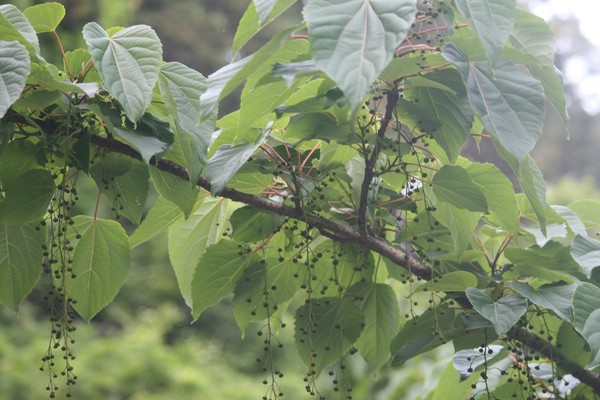
Idesia polycarpa ("Iigiri")
Japanese name: イイギリ (飯桐)
Scientific name: Idesia polycarpa
[Overview]
A deciduous tree more than 15 m tall, found in mountain areas.
The bark is whitish gray-brown and smooth.
The branches are thick and arranged in whorls.
The leaves are simple and alternate, ovate-cordate, 10–20 cm long and 8–20 cm wide, with a pointed tip.
The leaves have 5–7 veins arranged somewhat palmately.
The leaf margins have rather sparse teeth.
The petiole is 6–18 cm long.
The tip usually has 2 nectaries.
The plant is dioecious.
Both the male and female inflorescences are panicles 20–30 cm long and hang down.
The flowers have no petals.
The fruit is a spherical berry 0.8–1 cm in diameter that ripens orange-red and often remains on the branches until the following year.
[Cultivation]
Propagate by cuttings or root cuttings.
Growing from seed is also possible, but seedlings will turn out to be both male and female plants.
When sowing, harvest the ripe fruit, wash off the pulp, bury the seeds in moistened vermiculite or similar so that they do not dry out, and store them in a cool, dark place; take them out in March–April of the following year and wash them thoroughly once more before sowing.
It prefers a sunny, fertile site that is well drained and retains moisture, and it dislikes strong sunlight hitting the trunk.
It dislikes strong afternoon sun and dry places.
When planted in the ground, it becomes a large tree and needs plenty of space.
For potted plants, water thoroughly when the soil surface dries; for plants in the ground, rainfall is sufficient.
Apply organic fertilizer around the plant in winter.
There are no particular pests or diseases.
[Notes]
The Japanese name derives from its resemblance to the kiri and from the use of its leaves to wrap rice.
Details
Translated from our Japanese encyclopedia. If anything differs, the Japanese page is correct.