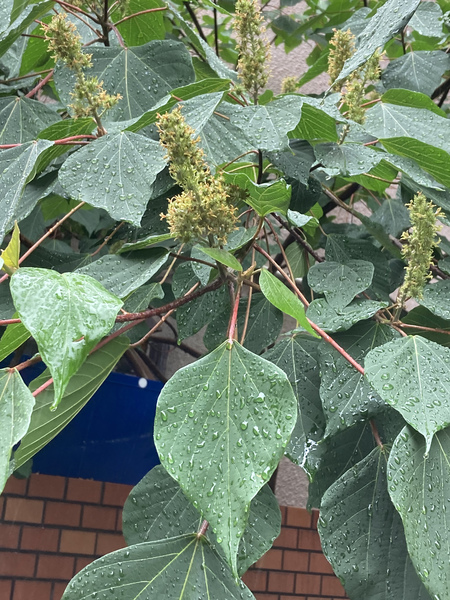
Japanese name: アカメガシワ(赤芽柏、赤芽槲) Scientific name:Mallotus japonicus
[Overview]
A deciduous tree up to 15 m tall, found in sunny wastelands, logged areas and secondary forests.
The crown is umbrella-shaped.
Young branches are densely covered with stellate hairs.
The leaves are simple and alternate, broadly ovate to ovate-lanceolate, and on young plants the tip is often 3-lobed.
Both surfaces of the leaves bear stellate hairs.
Young leaves are red and very conspicuous.
The leaves have long, reddish petioles.
It is dioecious.
Panicles 7–20 cm long emerge at the branch tips and bear dense flowers.
The axis of the inflorescence is densely covered with stellate hairs.
The flowers have no petals or disc, and in male flowers the numerous pale yellow stamens are conspicuous.
The fruit is a flattened-spherical capsule 8 mm in diameter, with hairs, glandular dots and spiny projections on the surface.
When ripe the fruit splits open and the black seeds show.
[Uses]
The bark and leaves are used medicinally.
The seeds, leaves and bark are used as dyes.
[Notes]
The alternative Japanese name Gosaiba is said to derive from the former practice of serving food on these leaves.