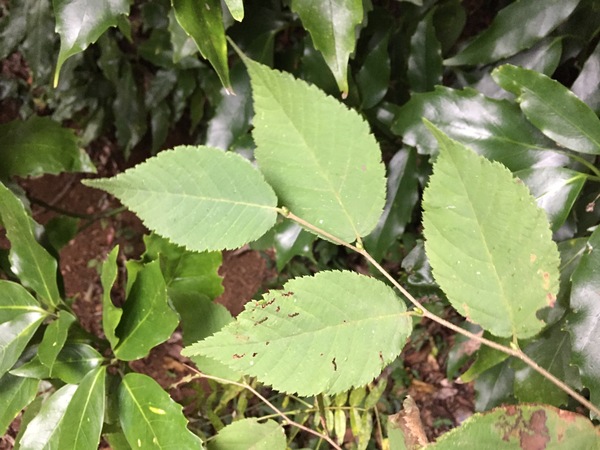
Japanese name: アサダ Scientific name:Ostrya japonica
[Overview]
A deciduous tree 15–20 m tall, found in deciduous forests in the mountains.
The bark peels off in thin vertical strips that curl back like hangnails.
Young twigs have hairs and glandular hairs.
Leaves are simple and alternate, ovate to oblong, 5–13 cm long and 3–6 cm wide.
The leaf margins have irregular double serration.
The leaves are at first densely covered with soft white hairs and velvety, but later the hairs remain only on the underside.
There are 9–13 pairs of lateral veins.
There are male and female flowers.
The male inflorescence is a catkin 1.5–6 cm long, which appears in the previous autumn, overwinters as it is, and blooms as the leaves unfold.
The female inflorescences are borne upward at the tips of new branches.
The female flowers are enclosed in bracts and borne in pairs.
The fruiting spikes are erect or drooping, 4–5 cm long, and the large bracts overlap, giving a shape like a bagworm.
The fruit is a nut enclosed in the bracts.