
Plant Encyclopedia

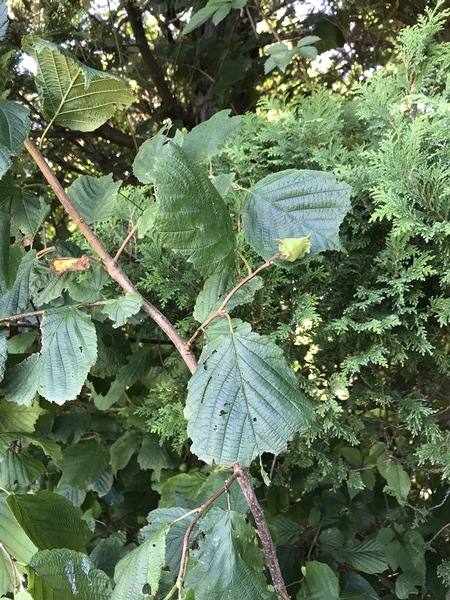
Corylus heterophylla (Asian hazel, "Hashibami")
Japanese name: ハシバミ (榛)
Scientific name: Corylus heterophylla
[Overview]
A deciduous shrub found at sunny forest edges in the mountains, reaching as much as 5 m in height in large specimens.
It sends out runners underground.
Young branches and leaf stalks bear soft hairs and glandular hairs.
The leaves are simple and alternate, triangular broadly obovate to broadly ovate-round or distorted semicircular, 5–12 cm in both length and width, with a straight or long-protruding tip and a heart-shaped base; they may sometimes be shaped like the leaves of Ohyo (Ulmus laciniata).
The leaf margins have irregular, deeply notched double serrations.
Leaf shape varies greatly.
The upper surface of the leaf is at first hairy but later becomes hairless, and the underside has spreading short hairs on the veins.
The leaf stalk is 0.6–2 cm long.
There are male and female flowers, which bloom before the leaves unfold.
The male catkins form in the leaf axils from the autumn of the previous year, and at flowering they extend to 3–7 cm long and hang down.
The female flowers gather in heads of 1–3 flowers and bloom while still enclosed in bud scales, with only the reddish purple stigmas showing.
The fruits grow in clusters of 1–3.
The fruit is a spherical nut 1.5 cm in diameter, enclosed in a leaf-like involucre 2.5–3.5 cm long.
The involucre is not beak-shaped; it is green, with teeth on the margin and no bristles on the outer surface.
[Uses]
The nuts are edible.
[Cultivation]
Propagate from seed, cuttings, layering, or division (of the runners).
It prefers a sunny, well-drained place with moderate moisture and dislikes strong dryness.
For potted plants and plants recently planted in the ground, water thoroughly when the soil surface dries; for established plants in the ground, rainfall is sufficient unless summer brings a long spell of sunny weather and the soil dries out.
Fertilizing can be sparing; while watching growth, apply organic fertilizer in winter.
Pests and diseases include powdery mildew and longhorn beetles.
Details
Japanese: ハシバミ(榛)
Translated from our Japanese encyclopedia. If anything differs, the Japanese page is correct.