
Plant Encyclopedia

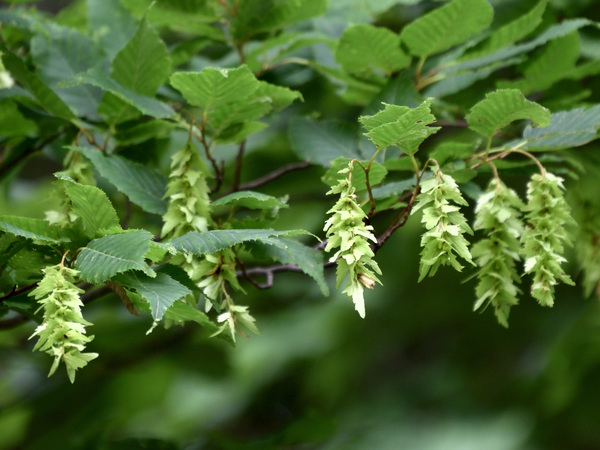
Carpinus laxiflora ("Akashide")
Japanese name: アカシデ (赤四手)
Scientific name: Carpinus laxiflora
[Overview]
A deciduous tree 10–15 m tall, found in somewhat moist, fertile places.
Young branches are usually tinged with reddish brown and are at first covered with long hairs.
The twigs are tinged with purple.
The leaves are simple and alternate in two rows, ovate to ovate-elliptic, 3–7 cm long and 2–3.5 cm wide.
There are 7–15 pairs of lateral veins.
The leaf margins have irregular fine double serrations.
The new shoots in spring are especially red and beautiful, and the leaves turn red in autumn.
There are male and female flowers, both borne in catkins, and they open as the leaves unfold.
The male catkins are 4–5 cm long and hang down from the leaf axils of last year's branches; the female catkins are borne at the tips of new shoots.
The fruit is a nut enclosed in a bract.
The bract is long ovate-triangular, 1–1.8 cm long, divided into 3 lobes at the base, with a few coarse serrations on one side only.
The fruit cluster is cylindrical, 4–10 cm long, and hangs down.
The fruit cluster has a stalk 2–3 cm long.
[Uses]
The wood is used for furniture, tools and utensils, decorative alcove posts, and as logs for growing shiitake mushrooms.
[Cultivation]
Propagate from seed, cuttings or layering.
It prefers a sunny site with soil that is well drained and retains water well.
Move potted plants to partial shade in midsummer so that the soil does not dry out too much.
For potted plants, water thoroughly when the soil surface dries; for plants in the ground, rainfall is sufficient.
Apply organic fertilizer in winter.
There are no particular pests or diseases.
Details
Translated from our Japanese encyclopedia. If anything differs, the Japanese page is correct.