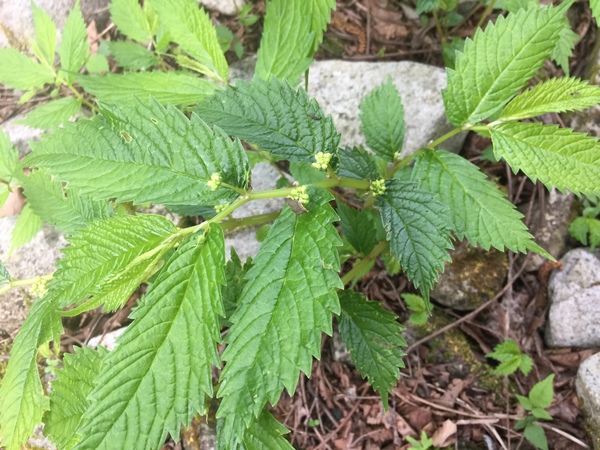
Japanese name: ウワバミソウ(蟒蛇草) Scientific name:Elatostema involucratum
[Overview]
A perennial that grows in damp places such as along mountain streams, often forming colonies.
The stem is succulent and either rises obliquely or hangs down a slope.
The stem nodes swell in late autumn and become bulbils (mukago).
The leaves are simple and alternate, 5–12 cm long, and asymmetrical, distorted oblong in shape.
The leaf tip is tapered like a tail, and the margin has coarse teeth.
There are 3–10 teeth on the inner margin and 6–13 on the outer margin.
Both leaf surfaces are sparsely covered with short hairs.
There are male and female flowers, both borne in head-like inflorescences in the leaf axils; only the male inflorescences have a stalk 1–2 cm long.
Each male inflorescence bears 15–30 flowers.
The flowers are greenish white and very small; male flowers have 4 tepals and 4 stamens, and female flowers have 3 tepals and a pistil.
The fruit is a pale yellow, ovoid achene about 1 mm long.
[Uses]
It is used as a wild vegetable and also medicinally.