
Plant Encyclopedia

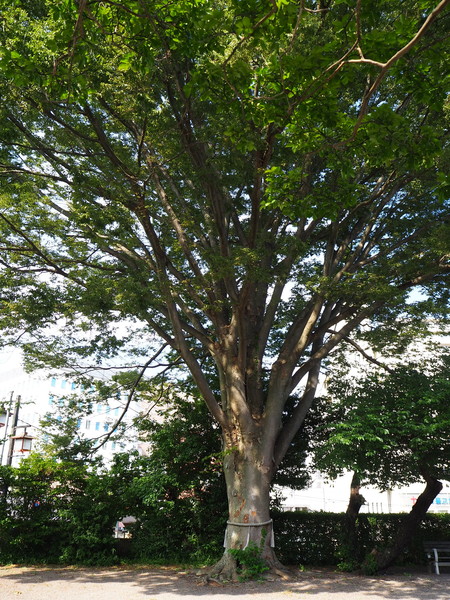
Zelkova serrata (Japanese zelkova)
Japanese name: ケヤキ (欅)
Scientific name: Zelkova serrata
[Overview]
A deciduous tree up to 30 m tall.
The crown is shaped like a half-opened fan.
On old trees the bark peels off in thin scales.
The leaves are simple and alternate, narrowly ovate to ovate-elliptic, 3–7 cm long and 1–2.5 cm wide, with a slightly rough upper surface.
The leaf margins have teeth that curve toward the leaf tip, and the lateral veins reach the tips of the teeth.
There is a very short leaf stalk.
The leaves turn yellow or red in autumn.
The leaves on flowering twigs are small.
There are male and female flowers; the male flowers grow in clusters or singly in the leaf axils at the base of the new twigs, and the female flowers usually grow singly in the leaf axils at the top of the new twigs.
The flowers have no petals and are small and pale yellowish green.
The fruit is a drupe with a distorted kidney shape.
The fruit falls together with the short leafy twig bearing it and is blown away by the wind.
[Uses]
The timber is of good quality and does not warp, and is used for construction, furniture and the like.
[Cultivation]
Propagate from seed or by cuttings.
It prefers a sunny, well-drained, well-ventilated, fertile site.
It is sensitive to dryness, so take care that it does not dry out when watering; for potted plants, water thoroughly when the soil surface dries, and for plants in the ground, water until they are established and for young trees.
For potted plants, apply organic fertilizer in winter.
Powdery mildew can occur.
[Notes]
The Japanese name is a variation of keyakeki (conspicuous tree).
Details
Japanese: ケヤキ(欅)、ツキ(槻)
Translated from our Japanese encyclopedia. If anything differs, the Japanese page is correct.