
Plant Encyclopedia

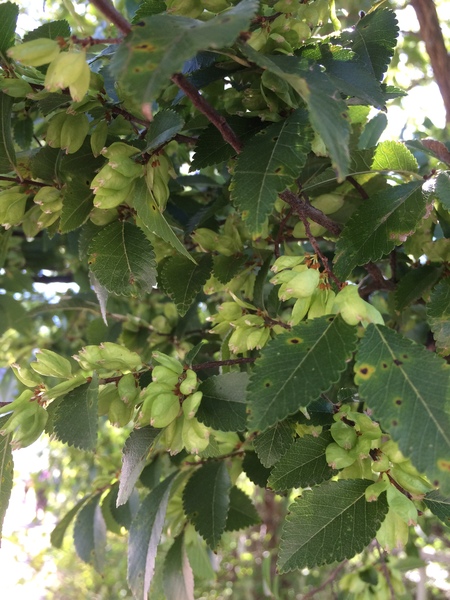
Ulmus parvifolia (Chinese elm, "Akinire")
Japanese name: アキニレ (秋楡)
Scientific name: Ulmus parvifolia
[Overview]
A deciduous tree up to 15 m tall with a trunk up to 60 cm in diameter, found in waste ground and on riverbanks.
The bark peels off in irregular scales, leaving mottled patterns.
Young twigs are densely hairy.
The leaves are simple and alternate in two rows, elliptic, 2.5–5 cm long and 1–2 cm wide, with an asymmetrical base.
The upper surface is glossy, and both surfaces have hairs on the veins.
The leaf margins have blunt teeth.
The leaf stalks are also hairy.
The flowers grow in clusters of 4–6 in the leaf axils of the current year's twigs.
The corolla is yellowish white, bell-shaped and 4-lobed, with conspicuous reddish anthers.
The fruit is a flat, broadly elliptic samara 1 cm long, with a wide wing along the edge.
Haru-nire is common in northern regions, whereas Aki-nire is also common in western regions.
[Uses]
The bark and leaves are used medicinally.
The wood is used as a substitute for Keyaki in kurimono (hollowed-out wooden articles) and household utensils.
The bark was used as a substitute for rope.
[Cultivation]
Propagate from seed.
As long as the site is sunny and well drained, it is not particular about soil.
It is easy to grow.
For potted plants, water thoroughly when the soil surface dries; for plants in the ground, rainfall is sufficient.
For fertilizer in winter, apply organic fertilizer in holes dug around the plant for plants in the ground, and use fertilizer placed on the soil for potted plants.
It tolerates pruning.
There are no particular pests or diseases.
[Notes]
The Japanese name means an elm that flowers in autumn.
Details
Japanese: アキニレ(秋楡)、イシゲヤキ(石欅)、ニレゲヤキ(楡欅)、ニレケヤキ(楡欅)
Translated from our Japanese encyclopedia. If anything differs, the Japanese page is correct.