
Plant Encyclopedia

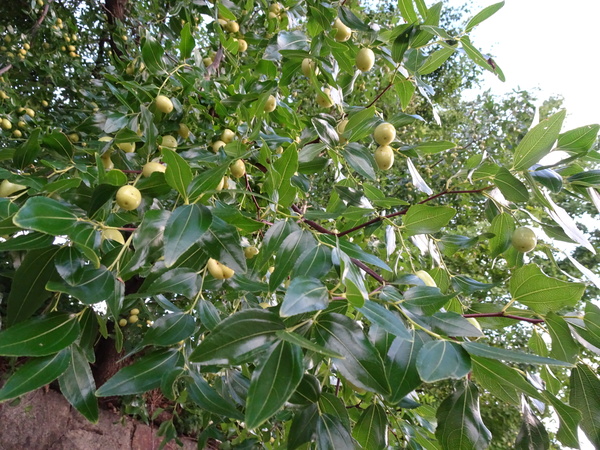
Ziziphus jujuba var. inermis (Chinese jujube, "Natsume")
Japanese name: ナツメ
Scientific name: Ziziphus jujuba var. inermis
[Overview]
A deciduous shrub or small tree 3–10 m tall, native to China.
The trunk is brown to grayish brown with vertical fissures.
The branches have no thorns (modified stipules).
The current year's branches are green and drooping, and young branches are purplish red or grayish brown and hairless.
The leaves are simple and alternate, ovate to ovate-elliptic, 2–7 cm long and 1–4 cm wide, with three conspicuous veins; the upper surface is dark green and glossy.
The base of the leaf is somewhat asymmetrical.
The leaf margin has blunt serrations.
The petioles of the leaves on the twigs are very short, and the whole twig can look like a pinnately compound leaf.
The flowers are yellowish green with 5 petals, 0.5–0.6 cm across, and several are borne in cymes arising from the leaf axils.
The sepals are ovate-triangular, larger than the petals, and yellowish green.
The fruit is a drupe, spherical to oblong, about 2 cm long and 1.5–2 cm across, ripening dark red.
The flesh (mesocarp) is sweet.
[Uses]
The fruit is eaten and used medicinally.
The wood is made into crafts and other items.
[Cultivation]
Propagate from seed, by division, root cuttings, grafting, cuttings or layering.
The optimum temperature for germination is high, 25–30°C.
Division is done with suckers.
It grows well in any soil as long as the site is sunny and well drained.
Take care not to overwater; for potted plants, water thoroughly when the soil surface dries, and for established plants in the ground, rainfall is sufficient unless sunny weather continues through summer and the soil dries out.
It tolerates dryness well.
Fertilizing can be sparing; apply a small amount of fertilizer in winter, watching how the plant is growing.
If there is a lot of rain during flowering, the number of fruits decreases.
Also, flowers and fruits easily drop in strong wind.
There are no particular pests or diseases.
Details
Japanese: ナツメ
Translated from our Japanese encyclopedia. If anything differs, the Japanese page is correct.